If your calendar is packed, Brazilian Jiu-Jitsu is one of the rare workouts that trains your body, clears your head, and teaches a real skill in about an hour.
New York moves fast, and most of us are trying to do a lot with limited time: long workdays, commutes, family responsibilities, and the constant mental noise that comes with living in a crowded city. That is exactly why Brazilian Jiu-Jitsu fits so well here. You can walk into class with your brain fried and walk out feeling steadier, stronger, and more capable.
We also like how honest the training is. There is no “pretend progress” in Brazilian Jiu-Jitsu. You feel what works right away, you learn what does not, and you improve through small wins that stack up. And because technique matters more than brute strength, you do not need an athlete’s background to start seeing benefits.
Below are five powerful, very New York-friendly ways BJJ supports your health, mindset, and day-to-day confidence, plus a few practical notes on how to fit training into a busy schedule.
1) Time-efficient, full-body conditioning that actually feels useful
A lot of NYC fitness routines look good on paper but fall apart in real life. Too much equipment, too much travel time, too much boredom, or workouts that never translate to how you actually move outside the gym. Brazilian Jiu-Jitsu is different because it trains your whole body through natural patterns: pushing, pulling, bridging, rotating, standing up, stabilizing, and breathing under pressure.
A single session can burn roughly 600 to 1,000 calories depending on intensity and body size, which surprises people who assume “martial arts” is mostly slow drilling. In reality, you get strength work, cardio, and mobility in the same hour. And since you are focused on a partner and a task, the time tends to move quickly.
Why it works for busy professionals
We structure classes so you get value even if you can only train two or three times per week. You do not need to “live at the gym” to feel a difference. With consistent attendance, students often notice:
• Better posture and core endurance for long desk days
• Stronger grip and pulling strength that shows up in everyday tasks
• Improved hip mobility that helps you move better on stairs and sidewalks
• Conditioning that feels more like real movement than treadmill time
If you are trying to replace multiple workouts with one that covers a lot of bases, Brazilian Jiu-Jitsu is hard to beat.
2) Stress relief that matches the intensity of NYC life
New York stress is not just emotional. It is physical: tight shoulders, shallow breathing, screen fatigue, and that feeling of always being “on.” Brazilian Jiu-Jitsu gives you a controlled environment to let the nervous system reset. You have to pay attention to your breathing, your balance, and your timing. That focus crowds out everything else for a while, in a healthy way.
After training, many students report a calmer mood and better sleep. There is a simple reason for this: you are working hard, you are solving problems, and you are getting a full-body endorphin release. You also practice staying composed when things feel uncomfortable, which is basically a life skill in New York.
What this looks like in practice
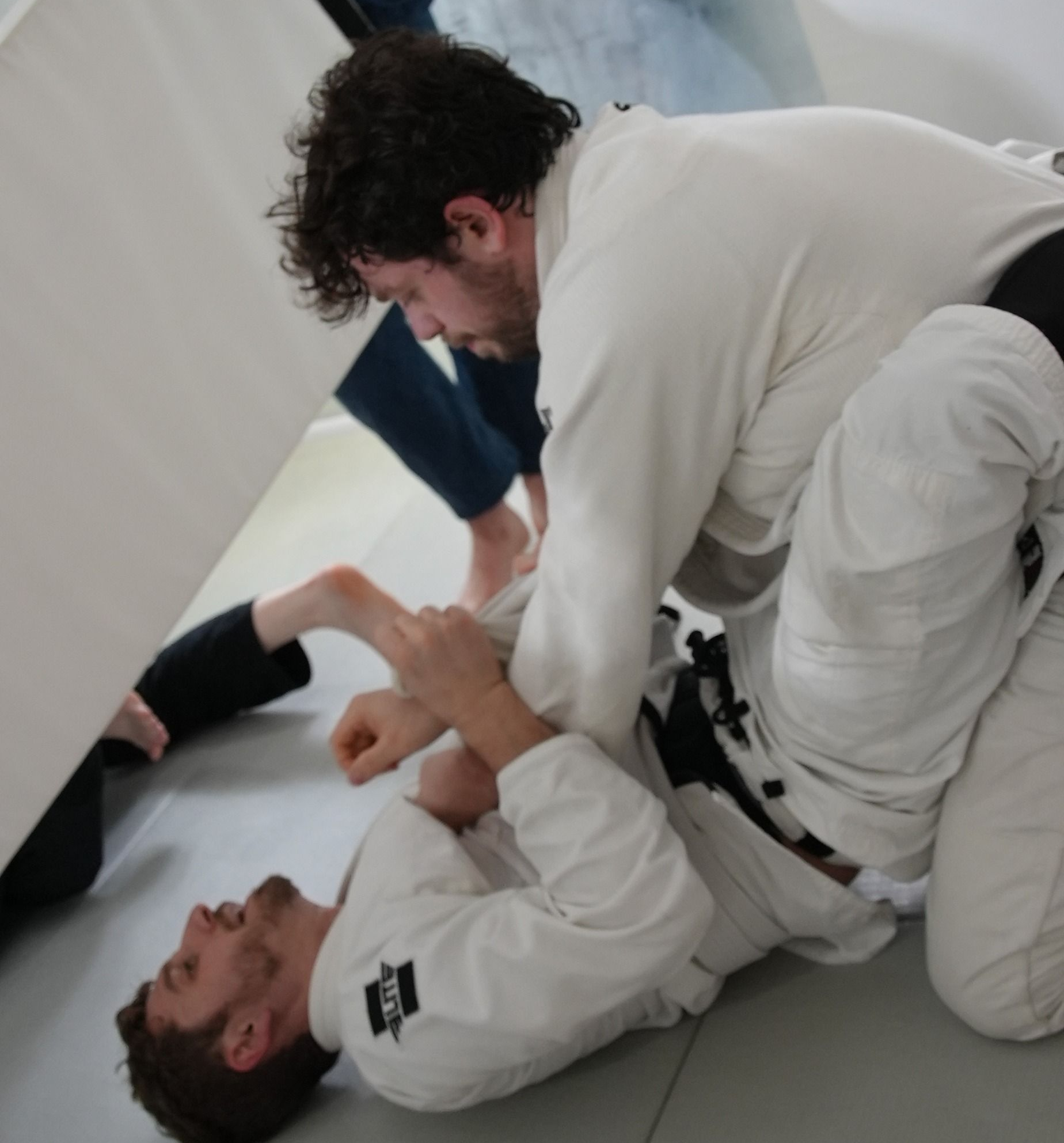
In class, you might start with a warm-up that loosens your hips and spine, drill a specific escape or control position, then do controlled sparring rounds. Those rounds can feel intense, but the goal is not to “win at all costs.” The goal is to learn how to stay calm, protect yourself, and make smart decisions under pressure.
Over time, that carries into daily life. The subway is delayed, a meeting goes sideways, your inbox explodes, and your body has already practiced not panicking.
3) Mental sharpness and resilience, because BJJ is a physical chess match
People sometimes come in expecting Brazilian Jiu-Jitsu to be mostly physical. Then the first time you roll with someone smaller who uses clean technique, it clicks: this is strategy. Every position has options, every option has counters, and your job is to recognize patterns quickly.
That is part of why BJJ has a reputation as a “physical chess match.” You learn to solve problems while tired. You learn to keep thinking while someone is trying to off-balance you. And you learn to make adjustments instead of quitting when the first plan fails.
Recent insights show that a large majority of practitioners report improvements in mental toughness and problem-solving, with 78% noting gains in those areas. That lines up with what we see: students start trusting their ability to figure things out, even when the situation is messy.
Skills you build that transfer to work and life
This is not motivational fluff. The mental habits are very real:
• Working through discomfort without spiraling
• Breaking big problems into smaller steps
• Staying present instead of catastrophizing
• Handling feedback without taking it personally
• Setting goals and showing up consistently
If you want a hobby that trains focus the way serious projects do, Brazilian Jiu-Jitsu in New York is a strong fit.
4) Practical self-defense and confidence without needing to “get bigger”
Self-defense in NYC is a common concern, but people do not always want a program that requires striking or emphasizes size and strength. Brazilian Jiu-Jitsu is known for helping smaller people control larger opponents through leverage, positioning, and timing. That does not mean technique is “magic,” but it does mean you are not relying on being the strongest person in the room.
We focus on fundamentals that matter: how to maintain balance, how to create space, how to stand up safely, how to control someone’s hips and posture, and how to protect yourself if you end up on the ground. You build confidence because you feel yourself improving in real time, not because someone tells you to feel confident.
A very NYC kind of confidence
For busy New Yorkers, confidence often looks like this:
• You walk with better posture and awareness
• You feel calmer in crowded spaces
• You are less rattled by physical pressure or surprise contact
• You trust your ability to protect yourself and create an exit
Even if you never face a serious situation, it is still valuable to know you can handle yourself. That sense of capability tends to spill into everything else.
5) Community and accountability that makes training sustainable
One of the most underrated benefits of Brazilian Jiu-Jitsu is the social side. New York can feel oddly isolating even when you are surrounded by people. Training creates a routine and a community that is built on shared effort. You learn names, you partner up, you nod at familiar faces, and before long you have a place in your week that feels grounding.
We also keep the environment structured and welcoming for beginners, because no one should feel lost or thrown into chaos on day one. When you are busy, the last thing you want is a confusing experience that wastes time. You want to show up, train, and leave feeling like you did something meaningful.
How we help you fit BJJ into a packed schedule
Consistency beats intensity. If you can train regularly, even in shorter blocks, you will improve. Here is a simple approach many NYC students use:
1. Pick two days that are realistically repeatable for you, not your “perfect week”
2. Treat class like an appointment and block it on your calendar
3. Show up 10 to 15 minutes early so you are not rushing onto the mats
4. Focus on one skill theme per month, like escapes or guard retention
5. Add a third day only when the first two days feel automatic
That structure keeps training from becoming another stressful obligation. It becomes the thing that helps you handle the rest of your life better.
A note for parents: youth training builds discipline without burning kids out
We also work with families who want something more meaningful than another screen-based activity. Youth Brazilian Jiu-Jitsu in New York can be a strong option for building coordination, confidence, and emotional regulation. Kids learn how to follow instructions, practice safely with partners, and handle small setbacks without melting down.
The best part is that progress is visible. A child who struggled with focus starts listening better. A shy kid starts speaking up. A high-energy kid learns how to channel that energy with control. And because the training is skill-based, kids stay engaged in a way that pure conditioning programs sometimes fail to deliver.
What to expect in your first few weeks
Beginners often worry that they need to “get in shape first.” We would rather you start now and let training be the thing that improves your fitness. Early on, you will learn how to move safely, how to tap, and how to train with control. You will also learn basic positions so rolling does not feel like random chaos.
Here is what most new students notice within the first month of consistent training:
• You breathe better under effort and recover faster between rounds
• Your body feels more athletic in daily movement
• Your mind feels quieter after class, like someone turned down the volume
• You start recognizing patterns and making smarter choices in sparring
That is the real hook: you are not just getting tired. You are learning.
Take the Next Step
Training works best when it fits your real life, not an imaginary schedule, and that is how we run things at Range Brazilian Jiu-Jitsu NYC. If you want an hour that delivers fitness, stress relief, and practical skill all at once, our approach to Brazilian Jiu-Jitsu makes it easier to stay consistent in New York.
Whether your goal is better conditioning, a clearer head, or a confidence boost that actually feels earned, we are ready to help you start with a plan that matches your week and your experience level at Range Brazilian Jiu-Jitsu NYC.
Build stronger grappling fundamentals and refine your technique by joining a Brazilian Jiu-Jitsu program at Range Brazilian Jiu-Jitsu NYC.