In a city that moves fast and asks a lot of you, training can be the one hour that gives you your body, focus, and confidence back.
Adult Brazilian Jiu-Jitsu is having a real moment in New York, and it makes sense: it blends fitness, self-defense, stress relief, and a surprisingly social training environment into one practice you can keep for years. New York City also has a deep BJJ scene, with one directory listing 106 Brazilian jiu-jitsu gyms out of 108 martial arts gyms in NYC, and Manhattan alone listed with 37 BJJ gyms, which says a lot about demand and access.
But access is not the same as feeling ready. Most adults who reach out to us are not worried about motivation, because New Yorkers are motivated. What usually holds people back is intimidation, time, safety, and the fear of walking into a room where everyone already “gets it.” Our job is to make Adult Brazilian Jiu-Jitsu feel approachable, structured, and realistic for your actual life in the city.
Why Adult Brazilian Jiu-Jitsu fits New York life
New York routines are intense: long workdays, crowded commutes, constant decisions, and not much mental quiet. Adult Brazilian Jiu-Jitsu gives you something rare here: a clear, physical problem to solve with your whole attention. For many students, that becomes the best kind of stress relief because you cannot half-focus on the mats. You are either present, or you are getting gently redirected by physics.
It also fits because it scales. You can train hard when you want to push your conditioning, or you can train smart when you are tired, traveling, or coming back from a busy week. The art rewards consistency more than intensity, which is good news if your schedule is unpredictable.
And yes, Adult Brazilian Jiu-Jitsu in New York is popular partly because it is practical. We train control, escapes, and positioning, not just “moves.” You learn how to stay calm when someone is close, heavy, and resisting, which is a very different kind of confidence than what you get from machines at a typical gym.
The barrier most adults feel: “I do not belong here”
A lot of adults assume the room will be filled with competitors or lifelong athletes. In reality, people start Adult Brazilian Jiu-Jitsu in their 30s, 40s, 50s, and beyond, and no prior martial arts experience is required. That reassurance shows up in beginner FAQs for a reason: it is true, and it matters.
We build our adult program around the idea that beginners deserve a clear path. You should not have to guess what to do, who to partner with, or whether you are “allowed” to ask questions. Our coaches set expectations early, pair people thoughtfully, and keep the pace productive without making it feel like you are drinking from a firehose.
There is also a social barrier in NYC that is easy to overlook: people can be guarded. One underrated benefit of BJJ in New York is that training gives you a built-in way to meet people without forced small talk. You drill, you learn names over time, and the community forms naturally.
What to expect in a beginner adult class
Most beginner-friendly adult classes follow a structure that is designed to keep you safe and learning. You do not need to be “in shape” first. We use class to get you in shape while teaching you how to move well.
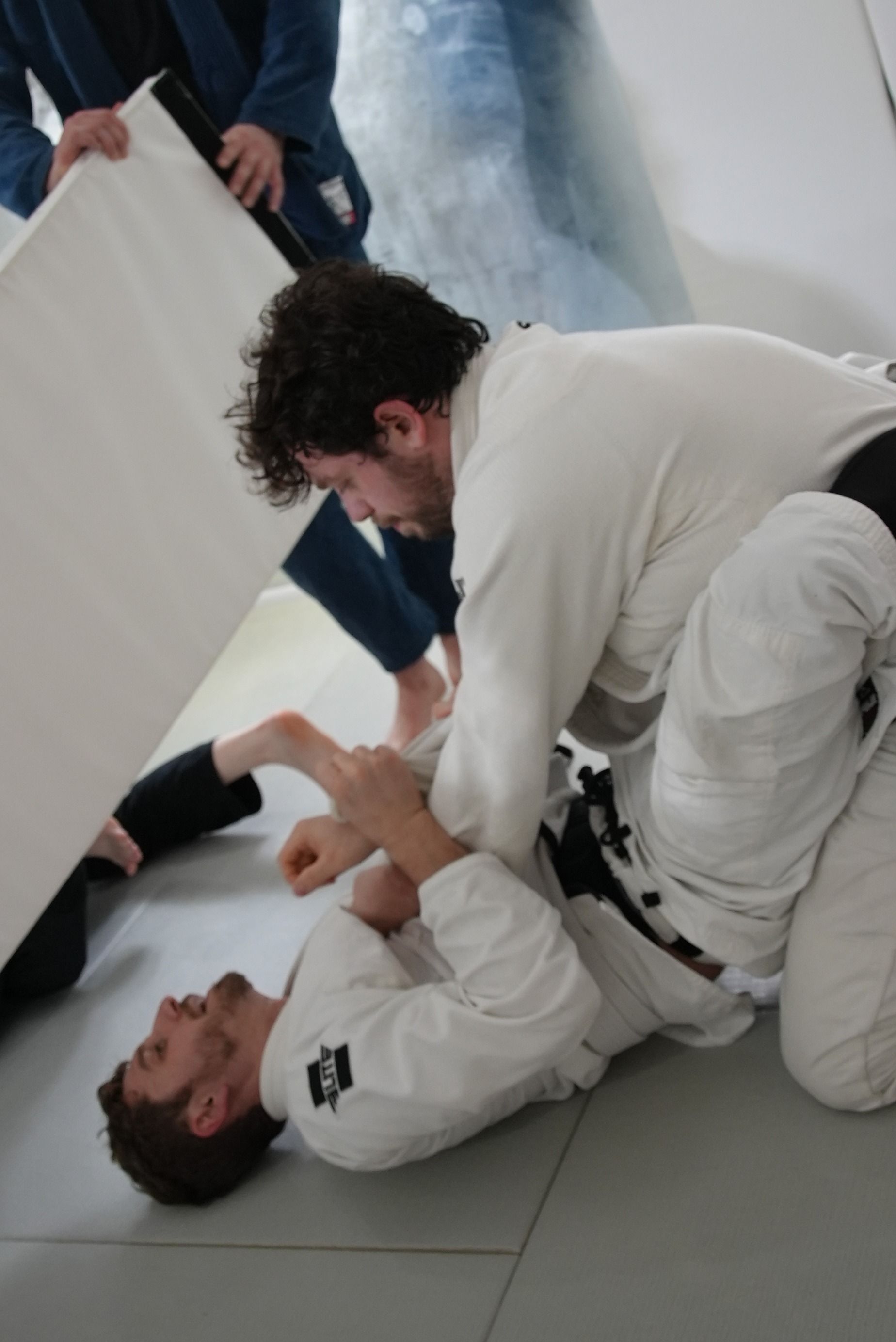
A typical session includes warm-ups, technique instruction, partner drilling, and optional light sparring rather than hard rolling on day one. If you are picturing a chaotic fight club, you can let that go. Early training is about positions, posture, breathing, and learning how to make contact without panic.
The class flow, step by step
1. Warm-up and movement basics that support safe grappling, like hip escapes and controlled get-ups
2. Technical instruction where we explain a position and one or two core options, not twenty things at once
3. Partner drilling at a pace you can sustain, with coaching and corrections while you work
4. Positional rounds that start from a specific situation, so you learn with structure
5. Optional sparring for students who are ready, with rules and supervision that keep it productive
If you are nervous about sparring, you are not behind. You are thoughtful. We treat sparring as a skill, not a rite of passage. Our goal is for you to train for months and years, not “win” your first day.
Safety and hygiene: how we keep training sustainable
In a dense city, trust matters. Adult Brazilian Jiu-Jitsu works when you can show up consistently, and consistency requires a training environment that respects safety and cleanliness.
We keep training sustainable by emphasizing controlled intensity and clear rules. That means tapping early, resetting often, and choosing training partners who match your experience and goals. It also means we actively coach positions that reduce injury risk, like how to frame, how to base, and how to move your hips without twisting under pressure.
Hygiene is part of safety too. Skin contact is real in grappling, so we set straightforward expectations: clean training gear, trimmed nails, and basic courtesy like showing up fresh and using footwear off the mats. These details are not glamorous, but they are what allow a room full of adults to train closely and still feel comfortable doing it.
Gi vs no-gi: which should you start with?
This is one of the most common questions we hear, and it is especially relevant right now because no-gi continues to grow. Trend coverage going into 2025 highlights the rise of submission-only formats and wrestling-based takedowns, which has made no-gi feel exciting and current.
Here is the simple version. In the gi, you wear a kimono and grips matter a lot. In no-gi, you wear athletic gear and the pace often feels a bit faster, with more emphasis on body locks, head position, and controlling transitions.
We do not treat this as an either-or identity issue. We help you choose a starting point based on your comfort, schedule, and goals, and we explain what each format teaches you.
Quick guidance we give beginners
• Choose gi if you want a slightly slower learning environment with clear gripping “handles” and strong fundamentals
• Choose no-gi if you prefer an athletic feel and want to build wrestling-style control and movement early
• Choose both if your schedule allows it, because skill transfer is real and it keeps training fresh
• Avoid overthinking the gear at first, because consistency matters more than the format
• Ask us how the program is structured week to week, so your classes connect instead of feeling random
Whether you start in gi or no-gi, we keep the focus on the same core themes: grip fighting (or its no-gi equivalent, hand fighting), positional awareness, and transitional control. Those are the fundamentals that make you hard to hold down and hard to rush.
Fitness, weight loss, and “real” conditioning
Adult Brazilian Jiu-Jitsu is honest conditioning. You are moving your body through awkward angles, carrying another person’s weight, and learning to breathe under pressure. It is not just cardio, and it is not just strength. It is coordination, balance, timing, and mental endurance.
If your goal is fitness or weight loss, we like setting expectations that are realistic for New York life. Two or three classes per week done consistently often beats a short-lived sprint of daily training. You will feel sore at first, especially in muscles you did not know you had, but soreness usually improves as your movement gets more efficient.
A benefit many adults notice after a few weeks is that training creates momentum. You start paying attention to sleep, hydration, and food choices because you can feel the difference on the mats the next day. We do not lecture about lifestyle, but the feedback loop is immediate, and it helps.
Self-defense and confidence without the macho stuff
A lot of people come to Adult Brazilian Jiu-Jitsu because they want self-defense skills, but they do not want an aggressive culture. We get it. The point is not to become a different person. The point is to become more capable as you are.
BJJ is a grappling art, so it shines in close range: clinches, grabs, and situations where balance and control matter. We focus on learning to protect yourself, escape bad positions, and create space to get up. Confidence comes from repetition under pressure, not from pretending you are fearless.
There is also a quieter type of confidence that shows up in daily life in New York. You start walking with better posture. You feel less reactive in stressful moments. You learn how to slow your breathing when your heart rate spikes. That carries over into work meetings, crowded trains, and everything else the city throws at you.
Scheduling BJJ in New York when life is packed
Convenience matters here. Training only works if it fits your commute and your energy. We encourage you to look at the class schedule like you would look at a calendar for anything important: pick realistic days, protect them, and treat training as a recurring appointment with yourself.
If you are starting from scratch, we typically recommend beginning with 2 to 3 sessions per week. That gives you enough repetition to improve without feeling like you are constantly recovering. If you can only make it once per week at first, we would rather you start than wait for the “perfect” season of life that never arrives.
One more practical point: give yourself permission to be a beginner. In a city full of experts, it can be hard to be new at something. But BJJ in New York is one of the few spaces where being new is expected, and progress is visible if you keep showing up.
What adult beginners ask most in NYC
New Yorkers ask direct questions, which we appreciate. These are the ones we hear constantly, and the answers we give are designed to help you start safely and confidently.
Am I too old to start?
No. Adults start in their 30s, 40s, 50s, and beyond, and the training can be adapted to your body and your goals.
Do I need prior martial arts experience?
No. We teach fundamentals from the ground up, and we assume you are learning the vocabulary and positions for the first time.
Is sparring required on the first day?
No. We introduce resistance gradually, and sparring is optional until you feel ready.
How often should I train as a beginner?
Usually 2 to 3 times per week is a strong, sustainable starting point for Adult Brazilian Jiu-Jitsu.
How much do BJJ classes cost in New York?
Many NYC gyms publish pricing in a similar range, about $150 to $250 per month for unlimited training, with drop-ins often around $20 to $40, and we are happy to talk through options so you can choose what fits your routine.
What to bring to your first class
You do not need to buy a lot to get started. For a trial class, a comfortable T-shirt and shorts or leggings are usually enough, and we will tell you anything specific you need based on the class type.
Bring the basics, and keep it simple:
- Water bottle, because you will sweat more than you think
- A small towel if you like having one nearby
- Athletic clothes without zippers or sharp parts that can scratch
- Flip-flops or slides for walking off the mats
- A mindset focused on learning, not proving anything
If you end up loving training, we can help you choose gear that fits well and holds up. But first, we want you on the mats, learning.
Take the Next Step
Building skill in Adult Brazilian Jiu-Jitsu is one of the most practical ways to feel stronger, calmer, and more capable in New York, and it starts with a first class that feels clear and welcoming. Our approach is structured, beginner-friendly, and designed for busy adults who want real progress without unnecessary risk.
If you are ready to try it in person, Range Brazilian Jiu-Jitsu NYC is set up to help you start safely, understand what you are doing, and enjoy the process while you build fitness and confidence over time.
Step onto the mats with confidence and start learning Brazilian Jiu-Jitsu at Range Brazilian Jiu-Jitsu NYC.