Brazilian Jiu-Jitsu gives you a place to put your attention, your breath, and your energy where it actually helps you.
Burnout rarely shows up as one big dramatic moment. For most adults in New York, it feels quieter and more constant: your shoulders live near your ears, your patience runs thin, your sleep gets lighter, and even “free time” doesn’t fully recharge you. We see it all the time, especially in a city that rewards being on-call.
Brazilian Jiu-Jitsu can be a surprisingly practical answer, not because it pretends life is stress-free, but because it trains you to respond differently to pressure. When you train with us, you get an hour where your phone stops mattering, your mind has to focus, and your body remembers what it feels like to work hard and recover on purpose. That pattern, repeated week after week, is how people start to feel like themselves again.
Why burnout hits hard in New York, and why movement helps
New York runs fast. Workloads are heavy, commutes can be draining, and social calendars somehow become another to-do list. Burnout often turns into a cycle: stress makes you tired, being tired makes you skip movement, and skipping movement makes stress feel even bigger.
We like Brazilian Jiu-Jitsu for adults because it does a few things at once. It gives you real physical training, yes, but it also gives you structure. You show up, you warm up, you learn, you practice, you breathe, you leave. That “container” is a relief when the rest of your week feels like a bunch of tabs open in your brain.
There’s also something important about training that is challenging but controlled. You’re not trying to destroy yourself. You’re learning to manage intensity, stay calm, and make good decisions while your heart rate is up. That skill transfers in a very New York way: crowded subway, tense meeting, deadline pressure, awkward conflict. You don’t become emotionless. You become steadier.
Brazilian Jiu-Jitsu as a reset button for your nervous system
One of the most consistent things adults tell us after class is that the world feels quieter. Not because problems disappear, but because your nervous system gets a different input. Rolling, drilling, and even just moving through techniques require attention and body awareness, and that focus interrupts the mental loop that fuels burnout.
The flow state effect: when your mind can’t multitask
Brazilian Jiu-Jitsu is hard to half-do. You can’t scroll while you train. You can’t “kind of” pay attention during live rounds. That’s part of the benefit. Many people experience a flow state, where attention narrows to the present moment. For someone dealing with burnout, that can feel like a clean mental break.
Flow state is not magic, but it is measurable in how you feel afterward: calmer, more grounded, more capable of making decisions. You’re not ruminating. You’re solving one small problem at a time, with your body involved, and that matters.
Stress inoculation: learning to breathe while it’s hard
Burnout can make small stressors feel huge. On the mat, we practice stress in a safe environment: someone is trying to control you, you get stuck, you problem-solve, you tap, you reset, you try again. That cycle teaches you that pressure is not an emergency. It’s information.
A simple example: if you hold your breath when things get tense, your energy disappears fast. In training, you learn (sometimes the hard way) to keep breathing and stay technical. Over time, you start doing the same thing at work or at home: pause, breathe, respond.
How our classes are structured to support adults, not overwhelm them
A lot of adults avoid starting because they assume it will be too intense, too complicated, or too “fight-y.” We get it. Our job is to make the learning curve feel doable and the environment feel safe, even when training is challenging.
What a typical class feels like
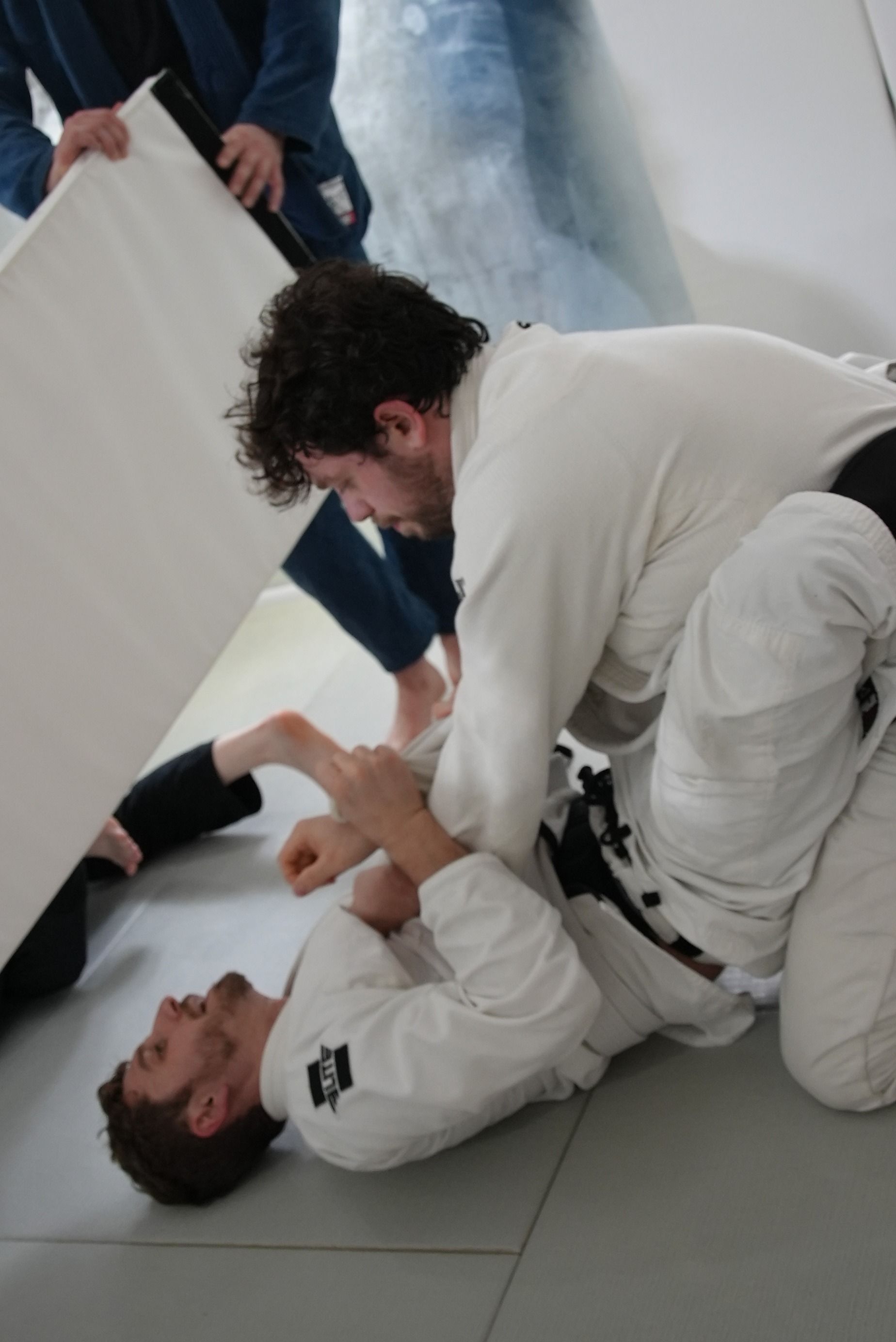
Most sessions include a warm-up that prepares your joints and gets your heart rate up, technique instruction that’s focused and progressive, drilling that lets you build confidence through repetition, and (depending on the class) controlled sparring. You’ll sweat, you’ll think, and you’ll leave with that satisfying tired feeling that helps you sleep.
If you’re brand new, we guide you through the basics without expecting you to “know the culture” already. You’ll learn how to move, how to tap, how to stay safe, and how to be a good training partner. That social ease is part of what helps adults stick with it.
A beginner-friendly approach without watering it down
Burnout often comes with a fragile kind of motivation. You want to improve, but you don’t want another thing that makes you feel behind. Our beginner pathway is designed so you can show up consistently, learn fundamentals, and feel progress early, without needing to be an athlete.
You’ll still be challenged. You’ll still have moments where you think, “Wait, what just happened?” That’s normal in Brazilian Jiu-Jitsu. The difference is we keep the progression clear, and we keep the room supportive.
The mental health side of BJJ in New York: focus, mood, confidence
People often come in for fitness or self-defense and then realize the deeper benefit is mental. There’s solid reasoning behind that. Training engages attention, coordination, and problem-solving, and it can support neuroplasticity, which is the brain’s ability to adapt and learn. You’re practicing new patterns under stress, and your brain gets better at handling complexity.
You may also notice mood shifts. Intense physical activity is linked with changes in neurotransmitters like dopamine and serotonin, which are associated with motivation and emotional stability. We’re not promising Brazilian Jiu-Jitsu is therapy. But we are saying it can become a powerful part of your mental health toolkit, especially in a city where stress is basically background noise.
Confidence also shows up in a specific way. It’s not loud. It’s quieter and more grounded: you know you can learn hard things. You know you can stay calm in discomfort. That’s the opposite of burnout, which often makes you feel like you’re always one email away from falling apart.
Community is not a bonus, it’s part of the antidote to burnout
Burnout thrives in isolation. Even if you’re constantly around people in New York, it’s possible to feel weirdly alone. One reason adults keep training is that the room becomes a dependable community. You see familiar faces, you work together, you laugh a little between rounds, and you share a kind of effort that doesn’t require small talk to be real.
Group-based martial arts training is often associated with improved social well-being and reduced loneliness. Practically speaking, that looks like this: you start recognizing people, you get comfortable asking questions, and you feel like you belong somewhere that isn’t work. That matters more than most adults expect.
Here’s what we notice helps adults feel connected quickly:
• You work with training partners, so progress is shared rather than solitary
• You learn how to communicate clearly (tap, reset, try again) without ego
• You build trust through safe, controlled intensity
• You get welcomed back when you miss a week because life got messy
• You realize improvement happens in seasons, not overnight
That kind of community support is a real counterweight to burnout’s “do everything alone” narrative.
Why Brazilian Jiu-Jitsu is uniquely effective for busy adults
Plenty of workouts exist. What makes Brazilian Jiu-Jitsu different is that it’s both physical and cognitive, and it scales across a lifetime. You’re not just burning calories. You’re learning a skill, and skill learning keeps people engaged.
It rewards consistency, not perfection
Burnout often comes with perfectionism. If you can’t do something at 100 percent, you do it at 0 percent. Training breaks that habit. On the mat, you can show up at 70 percent and still get better. You can drill lightly. You can focus on one position. You can train smart.
That’s also why BJJ in New York fits real schedules. You don’t have to “win” every session. You just have to come back.
It teaches boundaries in a physical way
Boundaries are easy to talk about and hard to practice. Brazilian Jiu-Jitsu makes boundaries literal. You tap when you need to. You reset when you’re overwhelmed. You learn what “too much” feels like early, and you learn that stopping is allowed. For adults who are used to pushing past signals, this is a big deal.
It turns stress into a solvable problem
In burnout, everything can feel vague and heavy. In training, stress becomes specific: escape the pin, recover guard, protect your neck, find a sweep. You learn to break big pressure into small tasks. That mental habit tends to show up outside the gym, too.
Getting started without adding more stress to your week
We keep onboarding simple because adults don’t need more friction. You don’t need to get in shape before you start. You don’t need to memorize moves from videos. You just need to show up and let the process work.
If you’re wondering how to begin, this is the basic rhythm we recommend:
1. Choose two classes per week that realistically fit your schedule
2. Focus on learning positions and survival basics before chasing submissions
3. Ask questions after class so small confusions don’t pile up
4. Track one small win each week (better breathing, calmer under pressure, cleaner movement)
5. Increase intensity gradually as your body adapts and your confidence grows
That approach works because it respects your real life. Burnout recovery is not about doing more. It’s about doing the right things consistently.
Brazilian Jiu-Jitsu in New York: thriving means more than coping
Thriving is not just “getting through the week.” It’s having energy left over. It’s sleeping better. It’s feeling capable in your body. It’s having a place where progress is tangible, even when work feels abstract.
Brazilian Jiu-Jitsu in New York can become that anchor. You train, you learn, you connect, and you develop resilience that isn’t motivational-poster resilience. It’s the kind built from doing hard things with good people and realizing you can handle more than you thought.
When you’re burned out, it’s easy to believe you need a grand reset. In reality, most adults improve through small, repeated experiences that remind the brain and body: we’re safe, we’re capable, we can recover.
Ready to Begin
If you want a practical way to step out of burnout mode and back into a steadier, more capable version of yourself, we’ve built our training environment to support that process. The goal is not to “tough it out” for one intense week, but to develop skills and routines that make you feel better month after month.
You can do that here, with coaching that keeps you progressing and a room that welcomes beginners without fuss. When you’re ready, Range Brazilian Jiu-Jitsu NYC is where you can turn Brazilian Jiu-Jitsu into a real part of your life in New York, not just something you try once.
Strengthen both your body and mind through Brazilian Jiu-Jitsu by joining a class at Range Brazilian Jiu-Jitsu NYC.