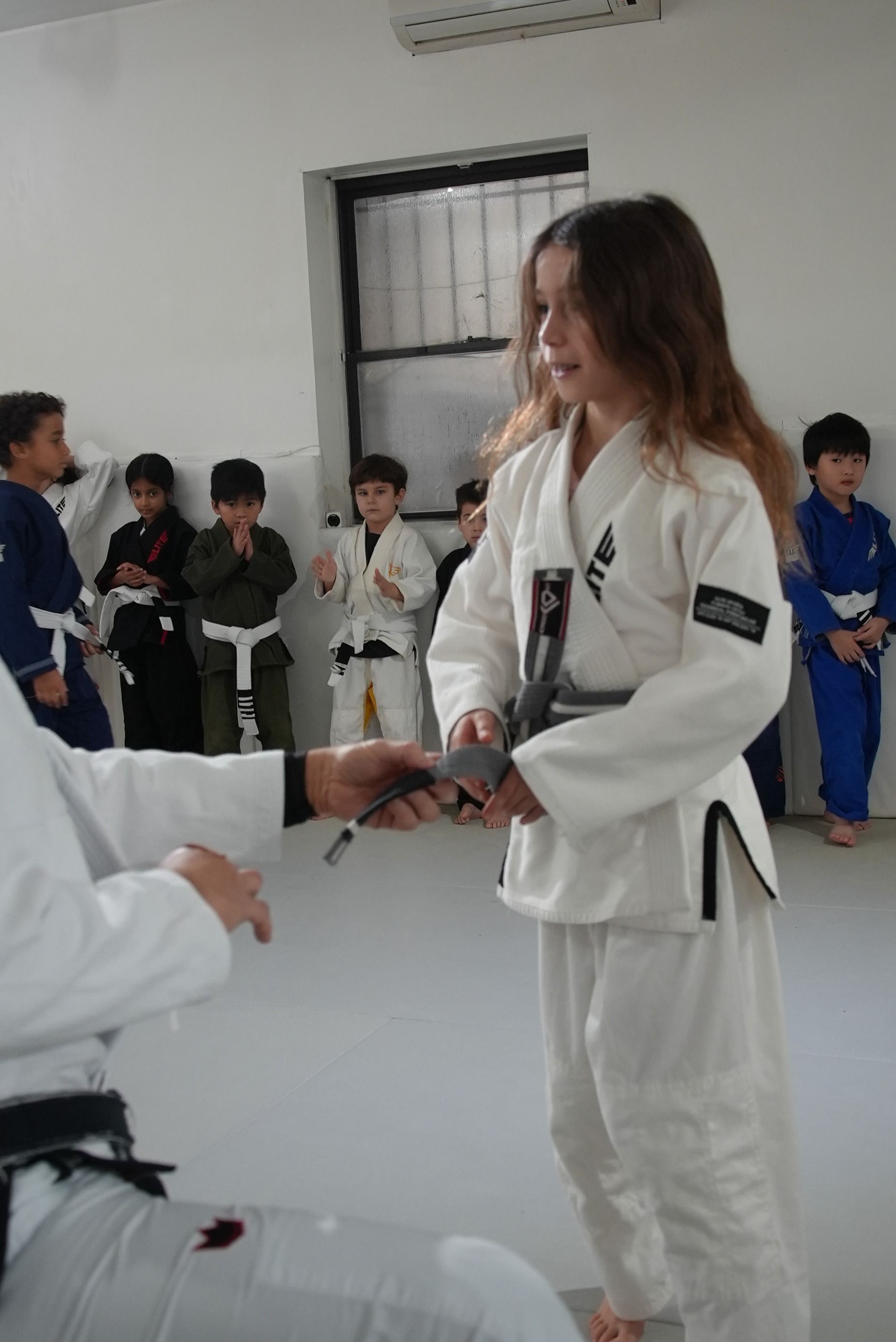
A good kids class does not try to make your child fearless, it teaches your child what to do when things feel uncertain.
New York kids grow up in a city that moves fast, asks a lot, and rarely slows down just because your child is having an off day. That is one reason Youth Brazilian Jiu-Jitsu can feel so relevant here. On the mats, kids practice meeting uncertainty in a structured way, with clear rules, close supervision, and a predictable routine that helps them settle in.
We also want to be careful with big promises. Direct research on youth Brazilian Jiu-Jitsu is still limited compared with broader youth martial arts research. What we can say, based on coaching experience and the patterns we see in class, is that the right training environment gives kids repeated chances to manage pressure, solve physical problems, and recover after setbacks. Over time, that is where courage and creativity start to show up in very practical ways.
What courage looks like in a Youth Brazilian Jiu-Jitsu class
When most people hear courage, we think of boldness. In kids training, courage is usually quieter than that. It is the moment your child decides to try again after getting stuck, or raises a hand to ask a question, or says, “Can we slow down?” without feeling embarrassed.
In Youth Brazilian Jiu-Jitsu, courage is decision-making, not fearlessness. Kids learn that it is normal to feel unsure in a new position, and that the next step is not panic or freezing, but a small, teachable action. We build this through repetition: a little challenge, then guidance, then another attempt, then a win that feels earned.
Courage skill 1: Trying again after a failed attempt
Grappling gives immediate feedback. A technique either works or it does not, and there is no way to “talk your way” out of the moment. That can sound intimidating, but in a well-run kids class it becomes a safe place to practice persistence. A child tries an escape, it fails, we reset, and we coach the next detail. Kids learn that failure is information, not a label.
Courage skill 2: Asking for help and using your voice
NYC kids often get praised for independence, but independence without communication can backfire in close-contact sports. We coach kids to speak up early and clearly. That includes asking the coach to watch a specific movement, telling a partner a grip is uncomfortable, or choosing to sit out for a minute if emotions are running hot.
Courage skill 3: Staying calm while the outcome is uncertain
In grappling, you rarely know what happens next. A partner shifts weight, the angle changes, the grip breaks, and your plan has to adjust. We teach kids to breathe, slow down, and take one step at a time. That calm focus is not just “toughness.” It is a skill, and it improves with the right kind of practice.
Why grappling develops creative problem-solving
Creativity in kids is often treated like an art topic. On the mats, creativity becomes practical. Youth Brazilian Jiu-Jitsu asks kids to solve the same problem in multiple ways: escape the hold, improve position, keep balance, or decide that pausing is the best move for a second.
Grappling is full of branching paths. If one option closes, a different option might open. That is a creativity lesson kids can feel in their bodies. And because the class is hands-on, kids who do not love long lectures can still shine. The learning is physical, quick, and surprisingly thoughtful.
One position, many answers
Take a basic example: a child ends up underneath a partner. There is rarely only one “correct” escape. Depending on size, flexibility, timing, and the partner’s movement, one child might bridge and turn, another might frame and recover guard, and another might create space first and then move. We coach principles, then help each student find what fits.
Constraints make creativity real
We often limit choices on purpose. A drill might allow only certain grips, or require a slower pace, or start from a set position every time. Those constraints are not meant to be frustrating. They are there because creativity grows when kids have a clear problem and a manageable set of tools to test.
Creativity is also knowing when not to force it
A surprisingly mature creative skill is choosing to reset rather than scramble. In Youth Brazilian Jiu-Jitsu, kids learn that “doing less” can be smart. If the position is unstable, slowing down and rebuilding balance can be the creative decision that prevents a mistake. That is a lesson many adults are still working on, honestly.
How kids learn to handle mistakes, pressure, and small setbacks
A youth class is not just techniques. It is a steady rhythm of trying, adjusting, and trying again. When kids get regular exposure to small setbacks, coached well, the setbacks start to feel less dramatic. That is the real developmental mechanism: practice under manageable pressure.
New York families also tend to have dense schedules. Kids bounce from school to after-school to homework to bedtime routines. We keep class structure consistent so your child knows what to expect. Predictability reduces stress, and it frees up attention for learning.
Here is what that pressure-to-progress pathway can look like over time:
1. Week 1 to 2: Your child learns basic mat rules, safe movement, and how to stop immediately when asked.
2. Week 3 to 6: Techniques start to connect, and your child realizes there is a “next step” even when stuck.
3. Month 2 and beyond: Confidence becomes more specific. Kids stop saying “I am bad at this” and start saying “I need to change this detail.”
4. Longer term: Courage and creativity show up outside class in small ways, like handling frustration, staying patient, or speaking more clearly about boundaries.
That progression is not perfectly linear, and kids have off days. We plan for that. Part of emotional regulation is learning how to come back after a rough class, not pretending rough classes never happen.
Safety, consent, and age-appropriate coaching in youth grappling
Parents ask the safety question early, and you should. All physical activities carry risk, and Youth Brazilian Jiu-Jitsu is not an exception. The meaningful question is how we reduce risk and how we respond when something feels off.
We build our youth program around controlled training, clear boundaries, and active supervision. We also keep techniques age-appropriate and focus on positional skill, movement quality, and partner cooperation, not intensity for intensity’s sake.
What safety looks like in day-to-day class
A safe class is made up of a lot of small choices, repeated every session. In our program, you can expect a focus on:
• Close supervision during partner drills and live training, with coaching that stays engaged instead of “hands off”
• Partner matching that considers size, experience, and temperament, not just age
• A strong emphasis on tapping, stopping immediately, and using words like “stop” or “too much” without any shame attached
• Clear rules around rough behavior, unsafe movement, and what happens if a child ignores boundaries
• Hygiene expectations that protect everyone, including clean uniforms, trimmed nails, and no jewelry on the mats
• Warmups that prepare joints and muscles for grappling movements, rather than exhausting kids before they learn
We care a lot about confidence, but confidence only counts when kids feel safe enough to participate fully.
What research says, and what it does not yet say
We want to be transparent because parents deserve that. Research that looks specifically at youth Brazilian Jiu-Jitsu is still emerging, so we avoid treating every positive claim as “proven.” The broader martial arts research base is stronger, and it often points toward promising social-emotional benefits when programs are taught in a supportive, well-structured way.
Here is the honest version:
• Research on youth martial arts in general suggests potential benefits for self-control, emotional regulation, and prosocial behavior, depending heavily on coaching quality and program design.
• A parent-reported survey focused on BJJ described improvements in confidence, anxiety, commitment, mental flexibility, and community connection, but parent surveys cannot prove cause and effect and can reflect selection bias.
• Adult BJJ studies cannot be treated as youth evidence. For example, a 2025 U.S. cross-sectional study associated BJJ participation with resilience, self-control, life satisfaction, and lower aggression, but it was adult-only and observational.
So what do we do with that? We treat Youth Brazilian Jiu-Jitsu as a structured practice that can support courage and creativity, especially when the training environment is age-appropriate, supervised, and consistent. We also keep listening to parents, watching how kids respond, and refining how we coach.
What New York parents should look for in a youth program
NYC has no shortage of enrichment options, and families are rightly selective. Large programs like the city’s Summer Rising served over 115,000 K through 8th grade students in 2024, which shows how high the demand is for supervised, structured activities. We aim to be the kind of weekly routine that actually fits a New York calendar.
When you evaluate Youth Brazilian Jiu-Jitsu in New York, focus less on marketing phrases and more on how the class runs minute to minute. A strong program should feel organized, calm, and clear.
A simple parent checklist before you commit
When you watch a class or bring your child in, here are a few practical things to notice:
• Do coaches explain drills in kid-friendly language and check understanding before starting?
• Do kids practice consent and boundaries, including stopping immediately when asked?
• Do beginners get a gentle on-ramp, or do kids get thrown into intense rounds right away?
• Is partner matching thoughtful, with coaches actively paying attention to size and experience?
• Is the space clean, and are hygiene expectations communicated clearly to families?
• Do coaches have a clear plan for injuries, behavior issues, and overwhelmed kids?
These details are not “extras.” For kids grappling, they are the foundation.
What a first class with us usually feels like
Most kids walk in with a mix of curiosity and nerves. That is normal, and we do not treat it like a problem to fix. We keep the first experience structured and welcoming, with a clear beginning, middle, and end.
Typically, your child will start with simple movement drills, learn a basic position or control point, and practice with a partner in a way that is coached closely. If sparring or live rounds happen, we keep it controlled and appropriate for the child’s experience level. And if your child needs a minute to watch before joining, we can work with that too.
Youth Brazilian Jiu-Jitsu works best when kids feel that class is a place to learn, not a place to perform. Over time, the mat becomes a small problem-solving laboratory: try, adjust, communicate, repeat.
Frequently asked questions from NYC families
Is Youth Brazilian Jiu-Jitsu safe for kids?
It can be appropriate when classes are age-specific, supervised closely, and built around control, consent, and progressive intensity. We encourage you to ask us directly about partner matching, tapping rules, and how we handle injuries.
Does grappling encourage aggression?
Our goal is control and cooperation. Kids learn to solve problems with partners, not “win at all costs.” We reinforce respect, stopping immediately, and protecting training partners.
What if my child is shy or nervous?
Shy kids often do well because progress is measured in small, personal wins. We can keep the introduction gradual, maintain predictable routines, and help your child build comfort step by step.
Does BJJ stop bullying?
We do not present Youth Brazilian Jiu-Jitsu as a guarantee against bullying. It may help kids build composure, body awareness, and assertive communication, but we also teach that the right response often includes leaving, telling an adult, and getting support.
Does my child need to compete?
Competition is optional. Many kids train for movement skills, confidence, friendships, and the simple satisfaction of learning something real.
Take the Next Step
Building courage and creativity is not about hype. It is about giving kids repeated, supervised chances to face small uncertainties, communicate clearly, and discover that there is almost always another solution. That is what Youth Brazilian Jiu-Jitsu can offer NYC families when it is taught with structure, care, and respect for childhood development.
If you want a program where kids learn to problem-solve under pressure without being pushed into unnecessary intensity, we built our youth training at Range Brazilian Jiu-Jitsu NYC around exactly that balance: challenging, supportive, and age-appropriate, with safety and consent as non-negotiables.
Develop stronger fundamentals and sharpen your grappling technique at Range Brazilian Jiu-Jitsu NYC.