A well-run kids class can turn “I can’t focus” into “I can try again” through structure, movement, and repetition.
New York families juggle a lot at once: school expectations, after-school logistics, homework, screens, tight apartments, and commutes that somehow eat half the day. When focus starts to feel slippery, many parents look for an activity that is physical, structured, and consistent, without needing a huge field or an all-weekend travel schedule.
That is where Youth Brazilian Jiu-Jitsu often gets attention. We see kids who struggle to sit still light up when learning with their bodies, and we also see focused kids become even steadier when the rules, routines, and goals stay clear from class to class.
Still, we want to be honest: Youth Brazilian Jiu-Jitsu is not a magic switch that guarantees better grades or “fixes” attention challenges. What it can do, when coached responsibly, is give your child repeated practice with the building blocks of focus: listening, waiting, remembering steps, managing frustration, and making decisions under pressure.
Why NYC parents are looking for focus-friendly activities
In NYC, consistency is half the battle. If an activity is hard to get to, depends on weather, or requires a long runway before your child feels competent, it often fades fast, even when the idea sounded great.
An indoor martial-arts routine can help because it is predictable. Classes start on time, the rules are steady, and progress is visible in small pieces. For many kids, that kind of structure makes it easier to settle in and actually engage.
There is also the social side. Kids are around peers, but they are not lost in a crowd. Youth training tends to rotate partners and tasks, so your child gets frequent “fresh starts” instead of being stuck in one role for an entire season.
What “focus” looks like in Youth Brazilian Jiu-Jitsu
Focus is not just sitting quietly. In a good class, focus includes several skills that show up in everyday life, too. Youth Brazilian Jiu-Jitsu gives us a simple way to practice those skills again and again, in a setting that feels active instead of purely academic.
Attention, but the usable kind
In class, kids have to track a coach’s voice, watch a demonstration, and pick out key details. If your child misses step two, step four will not work, and that feedback is immediate. That is useful, because it teaches attention with a purpose, not attention for attention’s sake.
Working memory and sequencing
Kids learn short movement sequences: grip, step, turn, base, and finish. Even when we keep it beginner-friendly, the child is still practicing “hold these directions in mind long enough to do them,” which is a big part of working memory.
Inhibition and impulse control
One of the most important rules is also one of the simplest: stop when we say stop. Live practice asks kids to control speed and intensity, avoid dangerous movements, and respect boundaries with a partner. That is impulse control in real time.
Flexible thinking under pressure
A partner is not a dummy. A partner pushes back, shifts weight, and surprises you a little. Kids learn to adapt instead of freezing, and they learn that “Plan A” is not always available. That mental flexibility overlaps with executive-function skills many parents care about.
What current research suggests about Martial Arts and executive function
When parents ask whether martial arts can help kids concentrate, we take the question seriously, and we also keep the claims grounded. A 2024 literature review found martial-arts training may improve attention and executive functions, including concentration, inhibition, working memory, and self-control. That is promising, but it is about martial arts broadly, not a guarantee for every child or every program.
We also know that movement quality matters for brain development. A 2024 systematic review and meta-analysis reported associations between children’s motor competence and executive functions, reinforcing the idea that activities requiring coordination, balance, sequencing, and decision-making may support cognitive development. If your child is practicing those pieces consistently, it makes sense that attention skills could improve alongside physical skills.
What we do not want to do is oversell the connection. Research can suggest relationships and likely mechanisms, but it does not turn a sport into a clinical treatment. For families managing attention concerns, Youth Brazilian Jiu-Jitsu can be a structured complement to healthy development, not a replacement for school supports, therapy, or medical guidance.
What we know and what we do not know about BJJ specifically
Brazilian Jiu-Jitsu has unique features: prolonged problem-solving with a resisting partner, constant decision-making, and a strong emphasis on safety rules and controlled intensity. Those features make BJJ a plausible “focus practice” activity.
At the same time, research specifically on youth BJJ is still limited. Much of the stronger evidence base is about martial arts in general, or about adult participants. That means we should avoid claiming that BJJ definitively improves academic performance, treats ADHD symptoms, or directly changes clinical outcomes, because the data is not there yet.
There is also supportive, but not definitive, evidence from the community itself. A 2025 BJJ survey study involving parents of youth participants reported strong perceived benefits in confidence, respect, commitment, emotional regulation, and life skills. The study relied on self-reported perceptions from one setting and did not include a control group, so we treat it as insight into what families commonly notice, not proof that BJJ causes those outcomes.
So where does that leave you as a parent? With cautious optimism and a practical next step: look at the structure of the program and how your child responds over time.
The BJJ learning loop that can support self-regulation
If you watch a kids class closely, you can see the “learning loop” happening in short cycles. That loop is a big reason Youth Brazilian Jiu-Jitsu feels different from many activities.
1. We demonstrate a technique and name the key points in plain language
2. Your child tries it slowly, often with a cooperative partner at first
3. A little resistance gets added, because real timing matters
4. Your child adjusts, sometimes mid-move, sometimes after it fails
5. We reset and repeat, with coaching that emphasizes calm effort
6. Over weeks, your child starts solving similar problems faster and with less frustration
That cycle teaches persistence without turning the room into a pressure cooker. The goal is not perfection in one class. The goal is steady practice and steady improvement, which is exactly the kind of mindset many NYC parents want for school and life.
Confidence and social growth without pushing “toughness”
A good youth program builds confidence in a specific way: not by hyping kids up, but by giving them evidence that effort works. When a child escapes a bad position after struggling with it for two weeks, it is hard to fake that kind of earned pride.
We also care about social skills that are practical, not performative. Kids learn to greet partners, take turns, and handle small awkward moments like mismatched sizes or different experience levels. That matters for shy kids and for big-personality kids alike.
We frame confidence as:
- Being able to try, fail, and try again
- Using a calm voice when something feels uncomfortable
- Respecting boundaries, including your own
- Knowing when to stop, tap, and reset safely
That is a healthier version of “tough” for most children.
Safety standards you should expect in a Youth Program
No contact sport is risk-free, so safety is not a slogan for us. It is a daily practice: how we structure classes, how we match partners, and how we keep intensity age-appropriate.
Recent research has criticized youth jiu-jitsu competition structures for lacking sufficiently specific scientific guidelines for gradual physical, technical, and tactical development. That is one reason we emphasize fundamentals and controlled progression, especially for beginners. We want kids to build skills in layers, not leap ahead because the room got too wild.
Here is what we consider non-negotiable in our youth room:
- Close supervision with clear mat rules, including immediate stops when instructed
- Thoughtful partner matching based on size, maturity, and experience, not just age
- A curriculum that prioritizes positional safety, controlled movement, and clean mechanics
- A culture where tapping and stopping are respected instantly, without teasing
- Clear communication with parents about injuries, hygiene, and readiness for harder rounds
If you are visiting for the first time, watch the coach’s eyes. A coach should be scanning constantly, not getting absorbed with one pair while the rest of the room turns into chaos.
Questions to ask before enrolling your child in NYC
NYC logistics matter. Even the best program will not help if attendance is inconsistent or if the schedule creates daily stress. Before you commit, it helps to get clear answers to a few practical questions, especially if you are exploring Youth Brazilian Jiu-Jitsu in New York for the first time.
• How do you bring beginners in: separate intro group, mixed class, or a structured on-ramp?
• How do you group kids: by age alone, or by developmental stage and experience?
• What does a typical class include: warm-up, technique, partner drills, and supervised live practice?
• What are the hygiene expectations: uniforms, nails, illness policies, and mat cleaning routines?
• Is competition optional, and if we never compete, can our child still progress and feel successful?
• What does communication look like: quick updates after class, email, or a clear point of contact?
When these basics are clear, kids usually settle faster, because the adults around them are not guessing.
How often should kids train for focus benefits?
We prefer consistency over intensity. Two days a week for months usually beats five days a week for two weeks. The habit is what sticks, and that habit is what gives your child repeated practice with attention and self-regulation.
Research has not established one ideal dose of BJJ for focus, so we do not pretend there is a magic number. Instead, we look at your child’s energy, school workload, and recovery. If your child leaves class more regulated and proud, that is a good sign you are in the right range.
If your goal is focus, we also recommend keeping the routine simple at home: same day, same time, same bag packed the night before. The fewer decisions you have to make on training days, the easier it is for your child to arrive ready to learn.
Youth Brazilian Jiu-Jitsu in New York: what to expect on day one
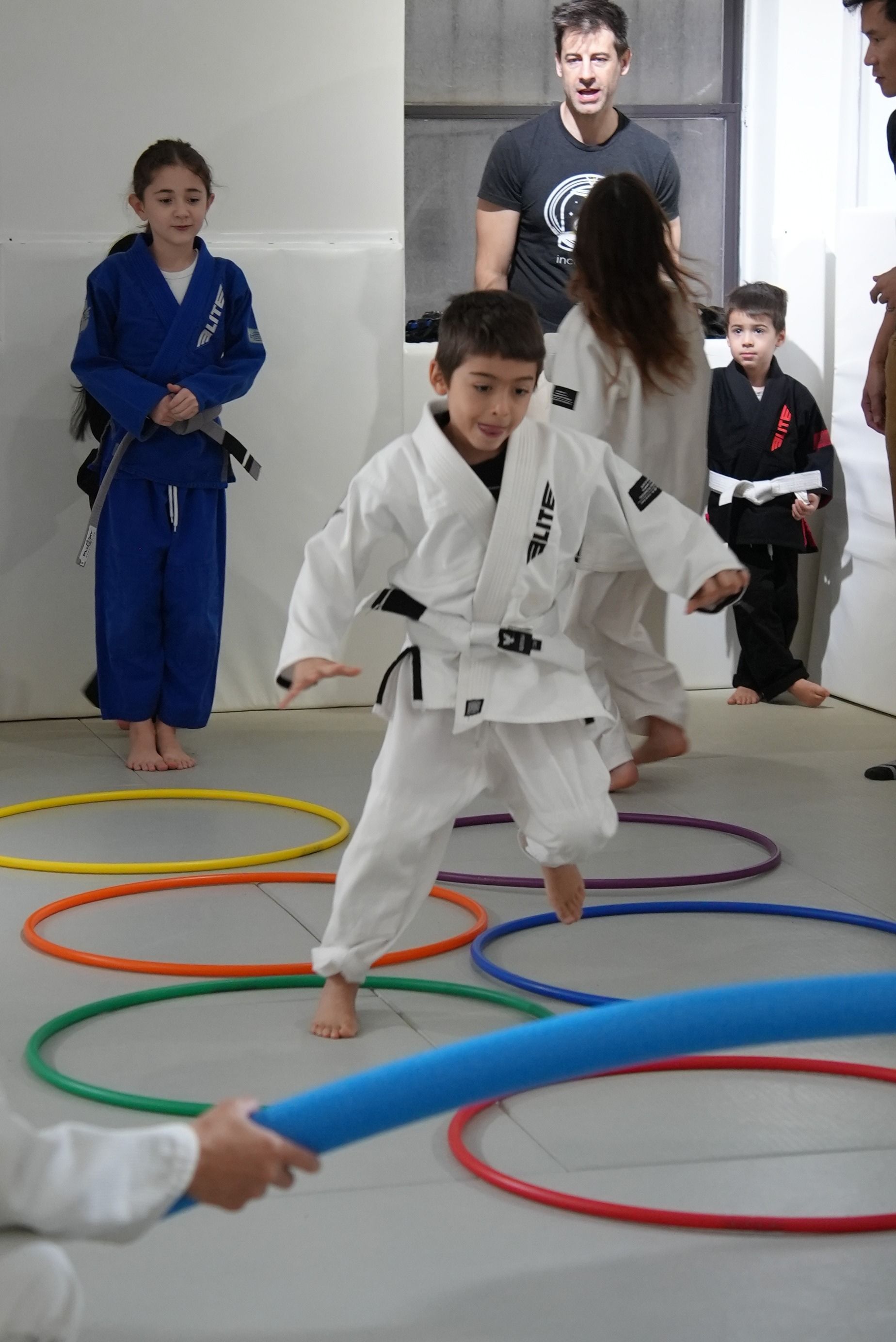
First classes should feel welcoming, not intimidating. We start with clear rules, introduce basic movements, and give kids quick “wins” so the experience feels doable. Expect your child to be a little unsure at first. That is normal, even for outgoing kids.
Most beginners improve in visible ways within the first month: smoother movement, better listening, less freezing when a partner pushes back. Those changes can spill over into school routines, especially around task persistence and handling mistakes, but we keep the expectations realistic. Youth Brazilian Jiu-Jitsu is practice, not a promise.
Take the Next Step
If you are exploring Youth Brazilian Jiu-Jitsu because you want better focus, steadier routines, and a healthier way for your child to burn energy, we can help you test the fit in a practical way. Our approach keeps structure high, coaching calm, and progress measurable, so you can see what your child responds to.
When you are ready, Range Brazilian Jiu-Jitsu NYC offers a youth experience built around fundamentals, safety, and steady development, the kind of training that supports confidence and self-regulation without making big medical claims we cannot prove.
Take your grappling skills further through consistent training at Range Brazilian Jiu-Jitsu NYC.