Brazilian Jiu-Jitsu turns fitness into a practice you can measure, feel, and actually stick with in New York life.
Wellness in New York usually looks polished on paper: steps, yoga, strength training, maybe a sauna session if your schedule cooperates. But a lot of those routines miss one thing that makes habits last - a clear skill that keeps unfolding and a community that notices when you show up. Brazilian Jiu-Jitsu brings both, and it does it in a way that fits the city’s pace instead of fighting it.
We see it every week in our classes: people come in looking for better conditioning or stress relief, then stay because training gives structure. Brazilian Jiu-Jitsu isn’t just “a workout.” It’s problem-solving under pressure, repeated often enough that you start handling pressure differently outside the gym too.
And if you’ve wondered whether this is just another trend, the numbers say otherwise. There are roughly 6 million Brazilian Jiu-Jitsu practitioners worldwide and about 750,000 in the United States, with interest doubling over the past decade. In a city where wellness options are endless and attention is limited, that kind of staying power matters.
Why NYC wellness routines often feel incomplete
A NYC schedule can be relentless. Even when you do everything “right,” the usual wellness stack can leave gaps: not enough full-body strength, not enough mobility under load, not enough mental decompression that lasts longer than the subway ride home.
We think of Brazilian Jiu-Jitsu as the connective tissue between common wellness goals. It combines strength, cardio, coordination, and mobility in one practice, and it offers a very real sense of progress. You can feel improvement week to week: you escape positions that used to trap you, you breathe more calmly, you move with less wasted effort.
There’s also the accountability factor. In the city, it’s easy to disappear into your own routine. On the mats, your training partners remember you. That simple social thread does a lot for consistency.
Brazilian Jiu-Jitsu is functional fitness that doesn’t get boring
Most people know the basics: you grapple, you learn leverage, you spar in controlled rounds. What’s less obvious until you train is how complete the physical training becomes over time. You’re pushing, pulling, bracing, rotating, framing, bridging, posting, and recovering. It’s strength training, but it’s not isolated to a single plane of motion.
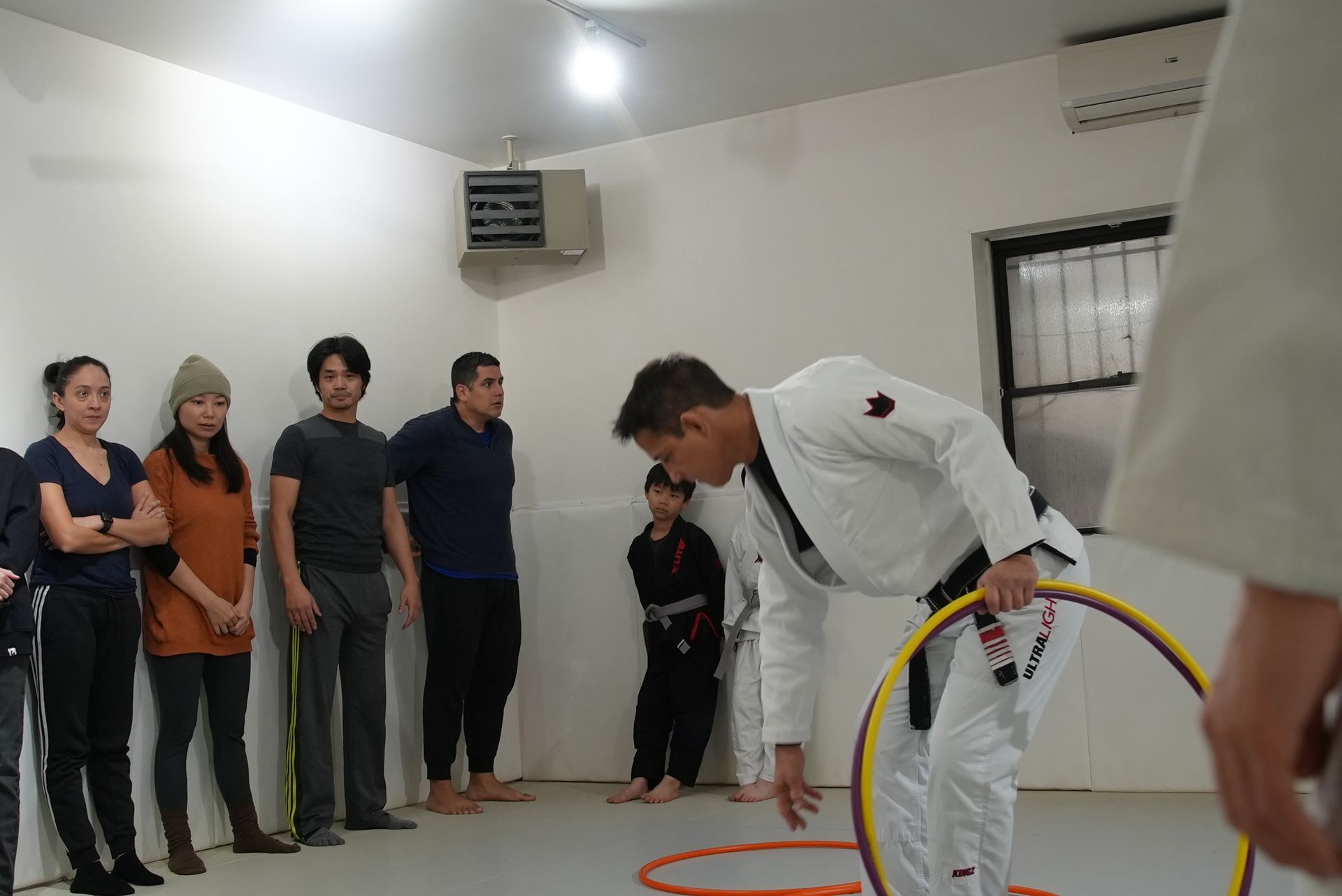
In our beginner classes, we focus on building a foundation that protects your body while you learn to move well. You’ll develop hip mobility and core stability without having to “chase” them as separate goals. The movement demands are baked into the techniques.
Brazilian Jiu-Jitsu also scales. If you’re a former athlete, you can lean into intensity safely as your skills catch up. If you’re getting back into training after a long break, you can move at a pace that makes sense. Either way, you still get the satisfaction of learning something real.
Stress relief you can feel, not just talk about
A lot of stress management advice is abstract. Breathing exercises, journaling, better boundaries - all useful, but hard to make stick when you’re busy. Brazilian Jiu-Jitsu is different because it forces you into the present moment. When you’re working through a position, you don’t have mental space to rehearse emails or replay meetings.
We coach you to recognize the difference between panic and pressure. Over time, you learn to slow down, frame properly, protect your neck, and solve the problem in front of you. It’s a physical skill, but it changes your mindset: you get more comfortable being uncomfortable.
For many New Yorkers, that’s the missing link. The mats become the place where your nervous system finally gets a clear message: you can handle this, breathe, move, reset.
The “measurable progress” problem: how BJJ solves it
A common wellness frustration is not knowing whether your effort is paying off. With Brazilian Jiu-Jitsu, feedback is immediate. When technique works, it works. When timing is off, you feel it. And because training is repeatable, you can track improvement without obsessing over metrics.
Belt progression also gives structure. Realistically, belts take time. Many people spend years at each level, and that’s not a flaw. It’s part of what makes the practice sustainable. Estimates across the sport often place white belt around 2.3 years, blue belt another 2.3 years to earn, purple belt around 5.6 years total to earn, and brown belt closer to 9 years to earn, depending on consistency and training quality.
We use that long runway as a benefit: you’re not “done” in 12 weeks. You’re building a skill you can keep refining for years in New York, without needing novelty to stay motivated.
A practical look at safety, injuries, and smart training
Injury risk is a fair concern, especially in a city where your body is your transportation. The answer isn’t pretending injuries never happen. The answer is structure: progressive training, clear tapping culture, and coaching that prioritizes longevity.
We teach you how to protect yourself early. That means learning to tap quickly, not “tough it out,” and understanding how joints and the neck should feel when pressure is applied. We also manage intensity so beginners aren’t thrown into chaos. Live training matters, but it’s introduced with guardrails.
A few simple habits go a long way, and we build them into class:
• Start every round by setting an intention like “focus on breathing” or “work escapes,” not “win”
• Tap early to joint locks and chokes, especially while you’re learning angles and timing
• Choose controlled partners when you’re new, and tell us if you’re sore or returning from time off
• Treat mobility and recovery as training, not optional extras you only do when you have time
• Ask questions after class so small issues don’t turn into bad patterns
Brazilian Jiu-Jitsu should make you more capable, not more fragile. Our goal is steady progress that you can sustain in a NYC lifestyle.
Why this fits New York specifically
New York has become one of the strongest markets in the country for Brazilian Jiu-Jitsu in New York, with a dense network of practitioners and a culture that values high-skill fitness. It’s also one of the most expensive places to train, with average monthly dues reported around 173.19 dollars. That price point can make people hesitate, so value and coaching quality matter.
We approach training as a real wellness investment. You’re not just paying for open gym access. You’re getting a curriculum, coaching, and a room full of training partners who help you improve. In a city where time is the rarest resource, that structure is often what makes the difference.
You’ll also notice that Brazilian Jiu-Jitsu fits the way New Yorkers like to train: efficiently. You can get a full session of learning, conditioning, and mental reset in one class. No bouncing between three different studios to cover all your bases.
What a week of training can look like with a busy schedule
Consistency beats intensity, especially at the start. Most people do best with two to three classes per week. That’s enough to build momentum, remember what you learned, and improve cardio without feeling like training is taking over your life.
Here’s a simple approach we recommend if you’re integrating Brazilian Jiu-Jitsu into your wellness routine:
1. Choose two recurring class days you can protect like appointments
2. Add one optional third class as a “bonus” when work and life cooperate
3. Keep strength training light at first so your joints adapt to grappling
4. Prioritize sleep and hydration on training nights, because recovery drives progress
5. Reassess after four weeks and adjust based on energy, soreness, and goals
Once your body adapts, you can dial up intensity or add sessions. But the early phase is about building a habit you can keep.
The social benefit: community without the small talk pressure
Wellness can get lonely in New York. You can lift next to someone for a year and never learn their name. On the mats, it’s different. Training partners have to cooperate to train safely, and that creates genuine connection.
We keep the culture focused and welcoming. You’ll still get that post-class chat, but you won’t be forced into anything. If you’re quiet, you can be quiet. If you want community, it’s there. Either way, you’ll feel part of something consistent, which is surprisingly rare in the city.
Youth Brazilian Jiu-Jitsu in New York: building discipline the right way
Adults aren’t the only ones who benefit from training. Youth Brazilian Jiu-Jitsu in New York is growing because families want something more meaningful than random activity hopping. When kids train, we focus on structure, respect, and confidence that comes from skill, not hype.
Youth classes give kids a place to practice listening, following directions, and staying calm when something feels challenging. The physical benefits are real too: coordination, balance, body awareness, and conditioning. But what many parents notice first is the mindset shift. Kids learn that progress comes from repetition, and that’s a lesson that carries into school and sports.
We also keep youth training age-appropriate and safe, with clear expectations and coaching that helps students feel successful while still being challenged.
The bigger trend: why BJJ keeps growing
Brazilian Jiu-Jitsu has become a major part of the fitness world, not a niche corner. In the US alone, the martial arts studio industry includes 44,218 studios generating 2.5 billion dollars in 2024 revenue and employing over 65,000 people, with BJJ ranking among the highest-earning martial arts on average per studio.
Competition trends also show how technical the sport has become. At ADCC 2024, submissions happened about 34 percent of the time, with chokes making up roughly 65 percent of those finishes, and wrestling-style takedowns playing a major role. Even if you never compete, that evolution matters because it improves coaching methods and raises the quality of training across the board.
For you, the takeaway is simple: you’re stepping into a well-developed practice with clear training methods, not a fad that disappears when the next boutique class shows up.
Take the Next Step
If your current routine has you feeling “healthy-ish” but not truly capable, Brazilian Jiu-Jitsu may be the missing link. It gives you skill-based progress, full-body conditioning, and a reliable way to discharge stress in a city that rarely slows down.
When you’re ready to experience it in person, our classes at Range Brazilian Jiu-Jitsu NYC are built to meet you where you are, whether you’re brand new, returning after time away, or looking for a steady training home in New York.
Take your first step into Brazilian Jiu-Jitsu training with confidence at Range Brazilian Jiu-Jitsu NYC.