In a city that never slows down, training gives you a repeatable way to show up, focus, and improve on purpose.
New York has a way of rewarding intensity and punishing inconsistency. Your calendar fills up, your commute stretches, and even good intentions can get squeezed out by the pace of the week. We see it all the time: you want a routine that sticks, not another short-lived burst of motivation. That is exactly why Brazilian Jiu-Jitsu works so well here.
Brazilian Jiu-Jitsu is more than a workout. It is a skill you earn in layers, a practice that asks for attention, patience, and the willingness to be a beginner for a while. And in NYC, that structured challenge can become an anchor point for your week, the place where discipline stops being a personality trait and starts being something you do.
When you train with us, discipline is not presented as a hype speech. We build it the practical way: clear fundamentals, measurable progress, and a room full of training partners who notice when you show up and when you do not.
Why discipline is different in New York
Discipline in NYC is rarely about willpower alone. It is about systems. If your training is inconvenient, vague, or intimidating, it will eventually lose to work deadlines and social plans. Our job is to make the path forward obvious, safe, and worth returning to.
One reason BJJ in New York keeps growing is that it fits real urban life. Classes have a beginning and an end. You can train hard in a relatively small space. You can improve without needing perfect weather, a huge gym setup, or hours of free time. That matters here.
There is also a mental shift that happens when you train consistently. The city can feel unpredictable, but the mat is oddly steady. You show up, you practice, you learn where you’re strong and where you rush, and you leave with a calmer kind of fatigue. Over time, that repeatability turns into discipline you can rely on.
Brazilian Jiu-Jitsu builds discipline through structure, not slogans
A lot of fitness routines fall apart because the feedback loop is fuzzy. You lift, run, or take classes and hope you are getting better. In Brazilian Jiu-Jitsu, progress shows up in specific, sometimes very obvious ways. You escape something that used to trap you. You hold position longer. You finally remember to breathe under pressure.
BJJ also has one of the clearest long-term progression models in sports. Belt advancement takes time, and that is part of why it builds lasting discipline. Nationwide data suggests average time spent at early belts is often measured in years, not weeks, and advanced ranks can take close to a decade. That timeline is not meant to intimidate you. It is meant to make the point: the art is designed for consistency.
When we teach, we break that long journey into short, winnable steps. Discipline grows when you can see what to do next, not when you are told to “grind harder.”
The quiet power of the beginner phase
Adult Brazilian Jiu-Jitsu in New York attracts people who are used to being competent. You might run meetings, manage teams, or handle complex work. Then you step onto the mat and realize you are learning a new language with your body. That can feel humbling, and honestly, that is where the discipline starts.
Beginners make the fastest progress when the expectations are clear. We focus on the fundamentals that keep you safe and help you participate right away: posture, base, frames, escapes, and simple submissions taught with control. You do not need to be athletic. You need to be consistent.
If you train for four to six weeks with steady attendance, most people notice tangible wins: better balance, less panic in bad positions, and a stronger sense of timing. Those early wins are not random. We plan for them because we know retention matters, especially in a city where distractions are everywhere.
Discipline on the mat becomes discipline off the mat
It is easy to say “training builds character,” but we prefer to be specific. Here is what we watch happen as people commit to BJJ in New York and start training like it is a real practice instead of a casual drop-in hobby.
You learn to manage discomfort without quitting. Not just physical effort, but the mental discomfort of being temporarily stuck. You learn to pause, problem-solve, and try again. That repeats dozens of times per class, and it builds a kind of steady patience that carries into work and relationships.
You also learn honest self-assessment. On the mat, results are immediate. If your technique is off, you feel it. If your base is weak, you get moved. That feedback is strangely freeing because it removes guessing. Discipline becomes less emotional and more factual: show up, refine, repeat.
And yes, your body changes too. Grappling develops strength, grip endurance, hip mobility, and cardiovascular conditioning. But the lasting discipline comes from the routine: you start planning your week around training because it makes you feel sharper.
The NYC factor: self-defense realism and everyday resilience
New York is not a movie, but it is crowded, fast, and occasionally chaotic. Most real altercations end up in close range, and many go to the ground. Brazilian Jiu-Jitsu specializes in control, positional dominance, and submissions, meaning you learn how to manage space and neutralize threats when things get tight.
We train with safety first. That means controlled drilling, progressive resistance, and partners who understand that you are here to improve, not to “win practice.” This is a big part of discipline too: you learn to respect the process and protect your training partners so everybody can come back tomorrow.
There is also a confidence that shows up in small ways. You walk differently when you know how to keep your balance. You handle confrontation differently when you know how to stay calm under pressure. In NYC, that calm is valuable.
What our adult program emphasizes (and why it keeps people consistent)
We build adult training around a simple idea: you should know what you are working on and why. Random technique of the day can be fun, but discipline sticks better when you can connect the dots from week to week.
Our curriculum and coaching focus on the skills that matter most for real progress:
• Fundamental positions and escapes that keep you safe under pressure and help you participate confidently in live rounds
• High-percentage submissions taught with control, so you learn mechanics first and intensity second
• Positional sparring that gives you focused reps instead of chaotic guessing, which speeds up learning
• Stand-up awareness and takedown entries that reflect modern grappling trends and improve overall athleticism
• Training habits like pacing, breathing, and recovery that make consistency realistic for busy schedules
That structure is what turns effort into momentum. You are not just “working out.” You are building a skill set with checkpoints along the way.
The belt system: long-term goals made practical
One reason Brazilian Jiu-Jitsu creates lasting discipline is that it respects time. Belts are not handed out for showing up twice a week for a month. You earn them through skill, understanding, and consistency, and that is why the journey changes people.
To make the timeline feel real instead of abstract, here is a simple way to think about it. These are broad averages, and your progress depends on training frequency, coaching, and how you approach learning.
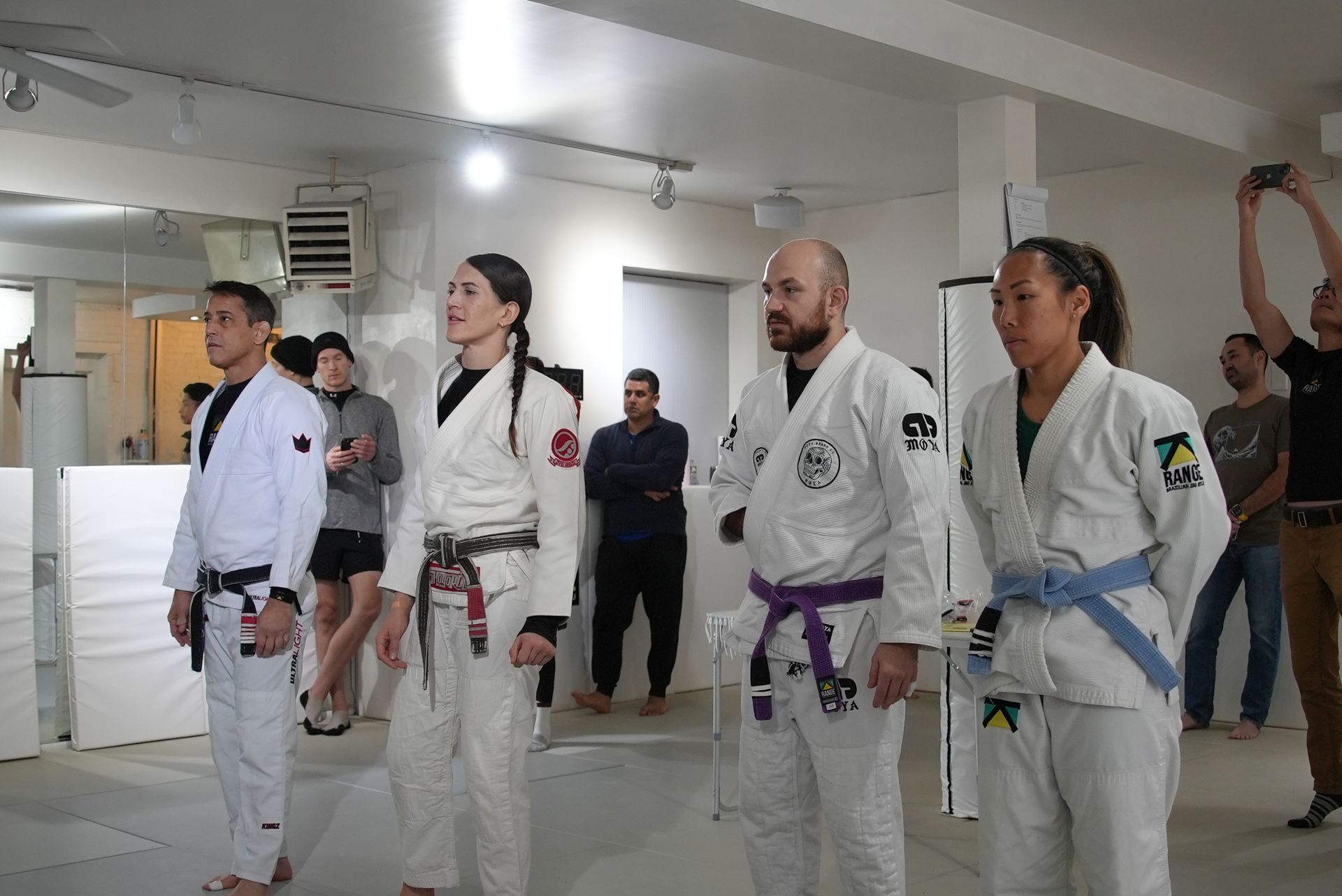
1. White belt: learning survival, core positions, and basic offense while building comfort in live training
2. Blue belt: developing a reliable game, connecting techniques, and sharpening timing under resistance
3. Purple belt: expanding strategy, improving transitions, and solving problems with less effort
4. Brown belt: refining details, controlling pace, and learning to impose your best positions consistently
5. Black belt: continuing development, deepening mastery, and adapting to new styles as the sport evolves
That long view does something important. It takes discipline out of the “new year, new me” category and places it into a craft. You show up because you are building something.
Community and accountability without pressure
People often underestimate how much discipline is social. If nobody notices whether you train, skipping becomes easy. On the mat, your absence is visible in a good way. Training partners ask where you were. Coaches remember what you have been working on. You feel part of something.
We keep the environment welcoming, but we do not make it fluffy. You will work. You will sweat. You will also laugh sometimes, usually after you realize you have been holding your breath for no reason. That mix matters. It makes the training room a place you can return to even on a long day.
If you are new to adult Brazilian Jiu-Jitsu in New York, we guide you through the early stage so you do not feel lost. Clear expectations reduce beginner drop-off, and we take that seriously: you should know how to warm up, what your goals are for the day, and how to train safely with different partners.
How to make discipline stick: a practical NYC training plan
Discipline is easier when you remove friction. If your goal is to become consistent, we recommend starting with a schedule you can actually maintain, not an ambitious plan that collapses in week two.
A realistic approach looks like this:
Train two to three times per week for the first two months. That frequency is enough to build continuity without burning you out. Put classes on your calendar like appointments. Treat them as non-negotiable unless something truly urgent comes up.
Track one small focus per week. Maybe it is keeping your elbows tight in closed guard, framing properly on bottom, or standing up safely from a scramble. One focus keeps your brain engaged and makes each class feel purposeful, which is a sneaky but powerful discipline tool.
Finally, allow yourself to be a beginner. The fastest way to quit is to compare your day-one performance to somebody’s year-five performance. The fastest way to build discipline is to compare yourself to last month.
What training teaches you about effort, control, and modern grappling
Brazilian Jiu-Jitsu keeps evolving. Recent elite competition trends show more wrestling influence and a continued emphasis on finishing mechanics, especially chokes, alongside strategic positional control. That matters for regular students because it reinforces a key idea: technique is alive. There is always something to learn, and discipline keeps you in the room long enough to absorb it.
In our classes, we balance fundamentals with modern applications. You learn core principles that never go out of style, and you also learn how to deal with the kinds of movement and pressure that show up in today’s grappling. That blend keeps training interesting and, importantly, keeps your discipline from getting bored.
And yes, you will have days where you feel “off.” That is normal. Discipline is not feeling great every session. It is showing up anyway, doing what you can, and letting the process compound.
Take the Next Step
If you want discipline that lasts, you need a practice that rewards consistency and gives you real feedback. That is what we build every day on the mat: structured coaching, clear progress markers, and a training culture where you can work hard without feeling like you have to prove something to anybody.
When you are ready to experience it in person, Range Brazilian Jiu-Jitsu NYC gives you a straightforward way to start Brazilian Jiu-Jitsu in the city and keep it going, week after week, until it becomes part of who you are.
Continue your Brazilian Jiu-Jitsu education beyond this article by joining a class at Range Brazilian Jiu-Jitsu NYC.