Brazilian Jiu-Jitsu turns “working out” into a skill you can feel improving every single week.
If you have ever walked out of a gym feeling like you did a lot but cannot quite explain what changed, Brazilian Jiu-Jitsu can be a refreshing shift. You still sweat, you still get stronger, and your lungs still burn a little on hard rounds, but your effort is tied to something concrete: timing, leverage, balance, and composure under pressure. That combination is a big reason Brazilian Jiu-Jitsu is exploding worldwide and why it fits so well into New York life.
In NYC, efficiency matters. Schedules are tight, stress runs high, and a workout has to earn its spot on your calendar. Brazilian Jiu-Jitsu in New York works because it trains your whole body and your nervous system at the same time. You leave with that “I did something real today” feeling, not just a number on a treadmill.
We also see people choose training for a more personal reason: they want a fitness routine that actually sticks. Skills-based training tends to do that. When you can track progress through better movement, sharper technique, and calmer decision-making, motivation stops being a pep talk and starts being curiosity.
Why Brazilian Jiu-Jitsu feels different from traditional fitness
Most fitness plans focus on isolated qualities: strength, endurance, mobility, or aesthetics. Those are valuable, but they can feel disconnected from daily life. Brazilian Jiu-Jitsu blends them into one practice because grappling demands coordinated strength, flexible hips and shoulders, and the ability to keep breathing while solving problems.
What really changes the “fitness” equation is that the workout is not the only goal. You are learning a physical language. You drill a movement, test it in controlled sparring, adjust, and repeat. That feedback loop makes training engaging even when you are tired or busy.
And it is not just a trend. The broader market for BJJ is projected to grow from about USD 1.2 billion in 2025 to USD 2.5 billion by 2033, driven partly by how well it develops functional strength, flexibility, and stress relief. That mirrors what we see on the mats every day: people come in looking for fitness and stay because the training changes how they feel in their bodies.
The NYC factor: time, stress, and the need for efficient training
New York has a way of compressing everything. A “quick” commute can become a detour, and a calm day can get loud fast. So when we think about adult Brazilian Jiu-Jitsu in New York, we design the experience around real constraints: limited time, high mental load, and a desire for a routine that feels worth it.
BJJ fits that reality because one class can cover:
• Strength and conditioning through grappling-specific movement
• Mobility work that shows up naturally in warmups and technique
• Cardio that changes pace constantly, like city life does
• Skill development that keeps you mentally engaged
• A clear end point, so you can return to your day without guessing if you did enough
There is also an interesting local detail: New York has the highest average BJJ monthly dues in the country at around $173.19. The upside of being in a premium, high-demand market is that students tend to value structure, quality coaching, and a schedule that makes training realistic long term. If you are paying NYC prices for anything, it should feel like it delivers.
Functional strength you can use, not just measure
Strength in Brazilian Jiu-Jitsu is not only about lifting heavier. It is about producing force in awkward angles, controlling posture, and staying stable while someone is actively trying to off-balance you. That is why BJJ builds what people often call “functional strength,” but we like to be specific about it.
You develop:
• Grip and pulling strength from controlling sleeves, wrists, and head position
• Core stability from resisting rotations and bridging under pressure
• Hip strength from guard retention, passing, and standing up safely
• Upper-back endurance from posture, frames, and connection to the mat
• Whole-body coordination because technique asks everything to fire together
In practical terms, you might notice that carrying groceries feels easier, your posture improves at your desk, and stairs stop feeling like a personal challenge. It is not magic, it is just your body becoming more organized under load.
Cardio that adapts to you (and improves faster than you expect)
A lot of people think they need to “get in shape first.” We disagree. You can start now and let the training build your engine gradually. One reason Brazilian Jiu-Jitsu in New York works for beginners is that intensity is adjustable. You can train with control, focus on technique, and still get a serious workout.
Your cardio improves because rounds fluctuate. You might spend 20 seconds scrambling hard, then settle into a controlled position where breathing and patience matter. That teaches recovery inside the workout, not just after it. Over time, you get better at staying calm while moving, which is a useful skill well beyond the mats.
Mobility and durability, built into the practice
When people say BJJ makes them “looser,” they usually mean their hips, ankles, and thoracic spine start moving better. Warmups, technical drills, and positional work expose tight areas quickly. You find out what is stiff, then you get reps improving it.
But durability matters more than flexibility. BJJ has injury risks like any contact sport. Data often points to knees as a common issue, with annual prevalence around 30 percent, including MCL and LCL involvement, and shoulders also show up frequently. We take that seriously because consistency is what transforms fitness, not occasional heroic sessions.
Our approach emphasizes:
• Progressive training volume so your joints adapt over time
• Technical precision over muscling through bad positions
• Tapping early and often, especially while learning
• Structured drilling before harder rounds
• Coaching that prioritizes safe mechanics in takedowns and scrambles
If you are returning to training after years away from sports, this matters. You want challenge, but you also want to be able to come back next week.
The mental workout: problem-solving under pressure
Brazilian Jiu-Jitsu is physical chess, but with sweat and real consequences when you make a mistake. That is not meant to sound dramatic, it is just the nature of grappling. You are constantly making decisions: where to place your weight, when to change direction, how to escape without giving up your back.
This is where many NYC professionals notice the biggest shift. Training builds a very particular kind of focus. You cannot scroll your way out of a bad position. You have to breathe, think, and execute. That practice of staying present transfers into work and life, especially for people who spend all day reacting to messages.
And yes, it is a stress reliever. Not because training is easy, but because it is absorbing. For an hour, your attention has one job.
Gi vs no-gi: two flavors of the same fitness transformation
If you are exploring Brazilian Jiu-Jitsu, you will hear about gi and no-gi. Both build fitness, but they feel different.
Gi training adds gripping, slower control, and more friction-based movement. No-gi tends to be faster, more scramble-heavy, and closer to wrestling-style exchanges. Competition trends have been showing more wrestling emphasis and evolving tactics, which makes standing skills and positional discipline especially valuable.
From a fitness standpoint:
• Gi often builds grip endurance and patience under pressure
• No-gi often pushes cardio and movement speed
• Both demand strong hips, a stable core, and smart breathing
We guide you toward the mix that fits your goals and keeps training enjoyable. Enjoyable matters because that is what becomes a habit.
What adult students actually experience in their first month
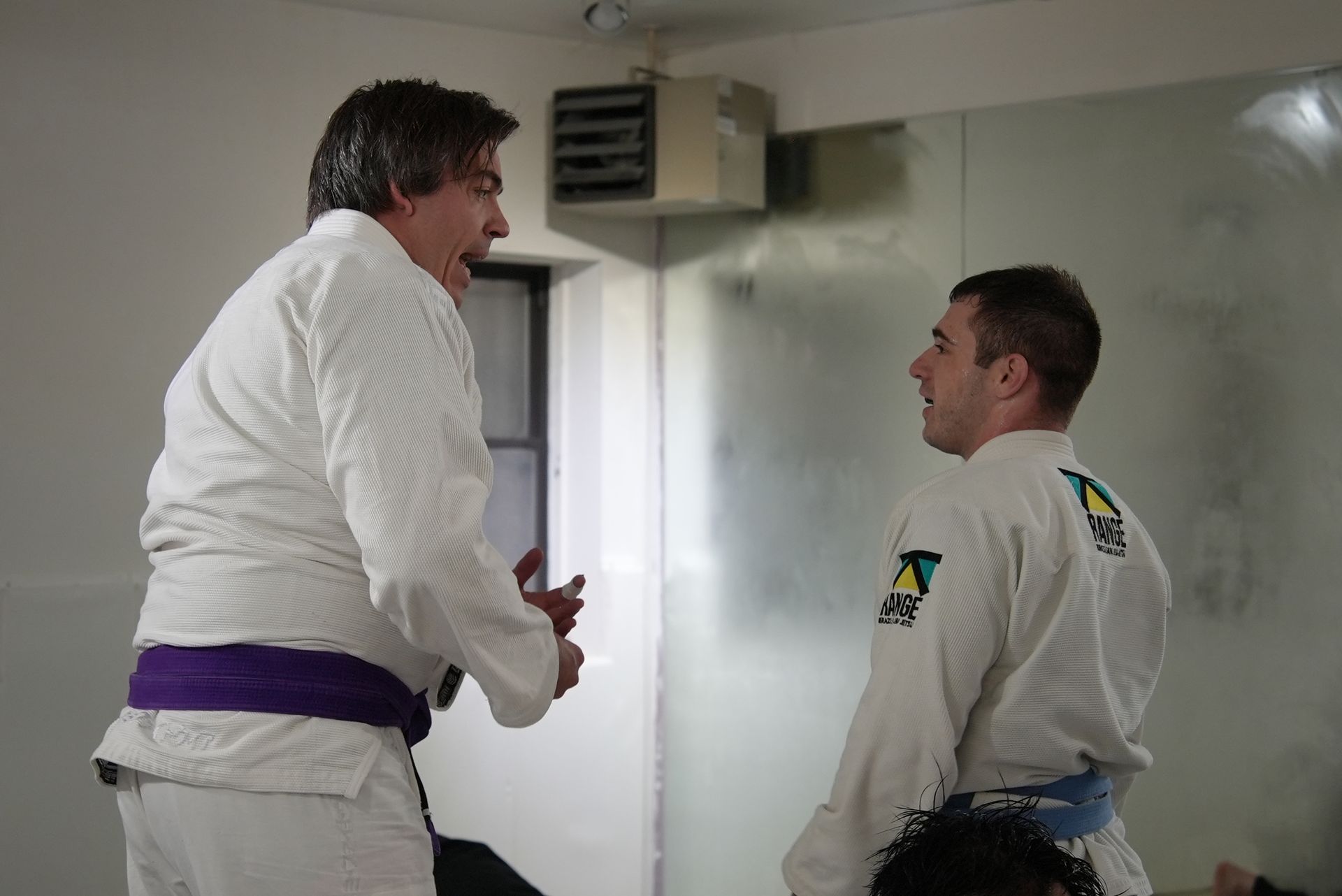
The first few weeks of adult Brazilian Jiu-Jitsu in New York can feel like learning to swim in a busy lane pool. You are not just tired, you are processing new information quickly. That is normal. The key is structure and realistic expectations.
Here is what we typically help you focus on early:
1. Learn a small set of positions so you can name what is happening
2. Build safe movement habits like framing, hip escapes, and base
3. Understand tapping as a skill, not a loss
4. Add controlled rounds where you can apply one goal at a time
5. Track progress through better decisions, not just “winning” exchanges
You will still get a workout. You will also get something more useful: a sense that you are building competence.
Measuring progress when belts take time
Belts in Brazilian Jiu-Jitsu take time, and that is part of the appeal. Globally, average timelines often look like roughly 2.3 years to earn blue belt, around 5.6 years to reach purple, and closer to 9 years to reach brown, with wide variation based on training frequency and consistency. That long arc helps fitness in an unexpected way. You stop chasing quick fixes and start building a practice.
encourage you to measure progress in multiple ways:
• Fewer panicked moments in bad positions
• Cleaner escapes that rely on timing, not strength
• Better balance and posture during movement
• Improved recovery between rounds
• More confidence showing up consistently
Those are real fitness markers, even if they are not printed on a smartwatch screen.
Building a routine that survives NYC schedules
The best program is the one you can repeat. We design training to fit real adult lives, including people balancing work, family, and all the usual city chaos. Consistency does not require perfection. It requires a plan.
A simple approach that works for many students:
• Train 2 days per week for the first month to build recovery capacity
• Add a third day when soreness drops and movement feels smoother
• Keep one session lighter and technique-focused when work is intense
• Use walking and basic mobility on off-days instead of “punishment cardio”
• Sleep and hydration like you mean it, because grappling exposes corners you can normally ignore
Brazilian Jiu-Jitsu rewards steady effort. If you train in a way you can sustain, the transformation is almost unavoidable.
Start Your Journey with Range Brazilian Jiu-Jitsu NYC
If you want fitness that feels purposeful, Brazilian Jiu-Jitsu is one of the most practical paths we can offer in New York. You will build strength, conditioning, and mobility, but you will also build something harder to find in a standard workout: composure, body awareness, and problem-solving under pressure that shows up in your everyday life.
At Range Brazilian Jiu-Jitsu NYC, we keep the focus on smart progression, safe training habits, and a class environment where you can work hard without feeling lost. If you are ready to trade “just exercising” for a skill you can grow into, we would love to help you take the first step.
See what makes training at Range Brazilian Jiu-Jitsu NYC unique by joining a Brazilian Jiu-Jitsu class today.