Brazilian Jiu-Jitsu turns the city’s nonstop pressure into focused effort you can actually feel leaving your body.
New York runs hot: crowded trains, long workdays, constant notifications, and a to-do list that somehow refills itself overnight. When adults look for a workout that truly relieves stress, we find most options miss something important - the mind keeps spinning even while the body moves.
Brazilian Jiu-Jitsu changes that. From the first class, your attention narrows to what matters right now: breathing, balance, posture, and solving a real-time problem with another person. That focus is a big reason adult Brazilian Jiu-Jitsu in New York has become a go-to for people who want more than a calorie burn.
We also like that it is measurable. You will feel improvement in small, specific ways: staying calmer under pressure, recovering faster between rounds, and making better decisions when you are tired. In a city like ours, that is not just fitness - it is a skill.
Why stress hits New York adults differently
Stress in NYC is not only emotional. It is physical and logistical. You are often carrying bags, standing for long stretches, rushing between meetings, and trying to stay alert in crowds. Even when you are “off,” your nervous system can stay on.
A lot of workouts help you sweat, but not all of them teach you how to downshift. We built our adult program to be a reliable reset, not a random spike of intensity that leaves you more wired than when you arrived. When you train consistently, your body starts to recognize hard effort as something you can control, not something that controls you.
BJJ in New York fits this perfectly because it rewards calm, patient problem-solving. You cannot muscle through every position. You have to breathe, frame, move your hips, and think.
The stress-busting science behind Brazilian Jiu-Jitsu
Stress relief is not just “feeling better.” It is chemistry and nervous system regulation. A good training session can lower perceived stress by giving your brain a clear task, your body a strong stimulus, and your mood a post-workout lift.
Here is why Brazilian Jiu-Jitsu works so well for adults:
• Full-body effort that is hard to fake: grappling uses legs, hips, core, and grip, which means you get a true workout without staring at a clock.
• Endorphin release and mood shift: intense, skill-based training can boost the “I can handle this” feeling that stress usually steals.
• A built-in mindfulness loop: if your mind drifts, you get swept, pinned, or submitted, so you learn to return to the moment fast.
• Healthy fatigue: the kind that helps you sleep better and feel less buzzy at night.
• Social connection: training partners become familiar faces, and that matters in a city where isolation can sneak in even when you are surrounded by people.
The American Council on Exercise has highlighted BJJ as a full-body fitness activity that can burn hundreds of calories per class while improving cardiovascular health and functional strength. That blend of conditioning and skill practice is a big reason it tends to stick as a long-term habit, not a short-lived phase.
Technique over toughness: why adults actually enjoy it
Some adults avoid martial arts because they imagine it is all aggression. In reality, the best training rooms are controlled and technical. Brazilian Jiu-Jitsu is built around leverage, timing, and position, which is why it works for different ages, sizes, and athletic backgrounds.
We coach you to solve problems step by step. Instead of “just go harder,” you learn how to build a base, protect your neck, create frames, and escape bad positions. That technical path is surprisingly comforting when your day-to-day life feels chaotic. You get a system. You get reps. You get progress.
And yes, you will sweat. But it is a purposeful sweat.
What a stress-relieving class feels like in real life
Most adults walk in carrying the day on their shoulders. After warm-ups, your breathing becomes louder, your posture wakes up, and your brain starts to quiet. Technique drilling is where many people feel the mental shift first: you have one job, one detail to fix, one movement to repeat.
Rolling (sparring) is where stress gets replaced by focus. You are not thinking about email. You are thinking about posture inside someone’s guard, how to stay balanced, how to escape side control. The clock runs out, you bump fists, you reset, and the world is oddly simpler for a while.
Then the class ends, and you step back into New York feeling more like yourself. Tired, sure. But steadier.
NYC safety reality: why grappling skills matter here
We take safety seriously, and we also keep it realistic. In an urban environment, many altercations end up in clinches, against walls, or on the ground. Brazilian Jiu-Jitsu is specifically designed for controlling distance, managing grips, and working from disadvantage to safety.
That matters for New Yorkers because space is limited. Sidewalks are tight. Train platforms are crowded. Learning how to keep your base, stand up safely, and control someone without panicking is a practical form of confidence.
We teach self-defense concepts alongside sport fundamentals, with an emphasis on awareness and decision-making, not reckless bravado.
How often should you train for stress relief without burning out?
Consistency beats intensity. For most beginners, training two to three times per week is the sweet spot. You build the habit, your body adapts, and your technique improves without feeling like your schedule is collapsing.
If you are busy (and in NYC, who is not), we recommend starting with two sessions weekly for a month. Then add a third day if recovery feels good. Your stress relief tends to improve as your timing and conditioning improve, so the first few weeks are about learning the rhythm.
A simple approach that works for many adults:
1. Weeks 1 to 4: 2 classes per week, focus on fundamentals and breathing.
2. Weeks 5 to 8: 2 to 3 classes per week, add more live rounds gradually.
3. Ongoing: maintain 2 to 3 classes per week, and use open mat when you want extra practice.
What you will learn first (and why it calms your nervous system)
Beginner training is not a random grab bag. We build foundations that help you feel safer, more capable, and more relaxed under pressure.
In your first phase, you will spend time on:
• Posture and base: staying stable so you do not feel “tossed around.”
• Escapes from pins: practical movements that reduce panic when you are stuck.
• Guard basics: using your legs and hips to control distance and create space.
• Simple submissions and defenses: learning what is happening so you can stay calm.
• Positional sparring: controlled rounds that let you learn without chaos.
This is a big reason Brazilian Jiu-Jitsu becomes a stress tool. You are training your brain to stay present and your body to stay organized when pressure shows up.
What to bring to your first class in New York
You do not need to over-prepare. Show up like you would for any athletic class, with a little extra attention to hygiene and comfort.
Bring:
• Comfortable athletic wear if you are starting without a gi
• A water bottle (you will use it)
• A small towel if you commute and want to freshen up after
• Flip-flops for walking off the mats
• An open mind, because day one can feel like learning a new language
If you are doing a trial, we can help you with what you need, including guidance on uniform options. Most importantly, arrive a little early so you can settle in and not feel rushed.
Why community is part of the stress relief (not an extra)
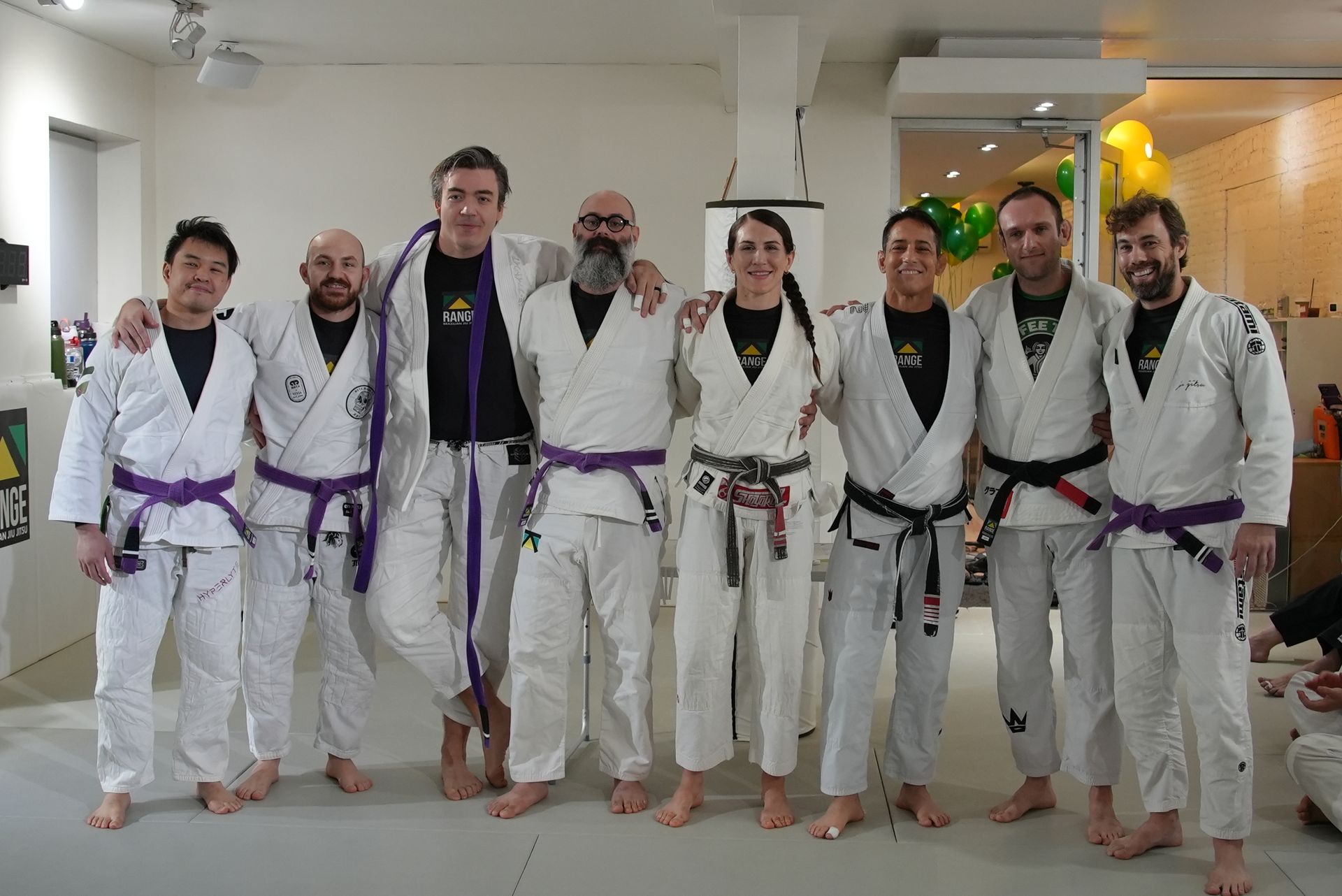
A lot of adult stress is social stress: feeling like you have to carry everything alone. Training gives you something rare in NYC - a consistent circle of people who recognize you, notice your progress, and help you improve.
You will train with partners of different sizes and styles. You will learn to communicate physically and verbally. You will get comfortable asking questions. Over time, that shared effort becomes a steady support system that extends beyond the mats.
We keep the training room respectful and structured, because psychological safety matters as much as physical safety when you are using training to manage stress.
Class options we use to meet adult goals
Adults do not all want the same thing. Some want stress relief and fitness. Some want practical self-defense. Some want a new challenge that feels real. We organize training so you can plug in without guessing where you belong.
If your schedule changes week to week, you can still progress. Our goal is to make the program compatible with adult life, not the other way around.
Why BJJ is growing fast (and why NYC adults are driving it)
Brazilian Jiu-Jitsu has grown dramatically worldwide, with estimates ranging from roughly 2.9 million to 6 million practitioners globally and hundreds of thousands in North America, including a large base in the United States. Growth has been fueled by visibility through MMA, the clear effectiveness of grappling, and the fact that adults can start without needing a lifetime of athletic background.
In NYC, that growth makes sense. People want training that does three jobs at once: fitness, skill development, and stress relief. BJJ in New York delivers that blend in a way that feels grounded. You get stronger. You get sharper. You get calmer.
And the best part is that progress does not depend on being the toughest person in the room. It depends on showing up, learning details, and staying curious.
Take the Next Step
Building a reliable stress outlet in New York is not about finding more noise. It is about finding something that demands your full attention in a healthy way, then sends you back into the city with a steadier mind and a stronger body. Brazilian Jiu-Jitsu does that, and it keeps doing it as you level up.
That is what we focus on every day at Range Brazilian Jiu-Jitsu NYC: adult-friendly training that respects your schedule, teaches real skill, and gives you a place to reset. If you are ready to try a class, we will help you start with a clear plan and a welcoming pace.
Continue your Brazilian Jiu-Jitsu journey beyond this article by joining a class at Range Brazilian Jiu-Jitsu NYC.