The fastest way for many kids to learn social skills is to practice them, repeatedly, in a structured room with clear rules and friendly partners.
In New York City, kids socialize all day long, but that does not always mean they get real practice with the skills that make friendships work. Crowded classrooms, busy schedules, and constant stimulation can make it harder for children to slow down, read cues, and respond with confidence and respect.
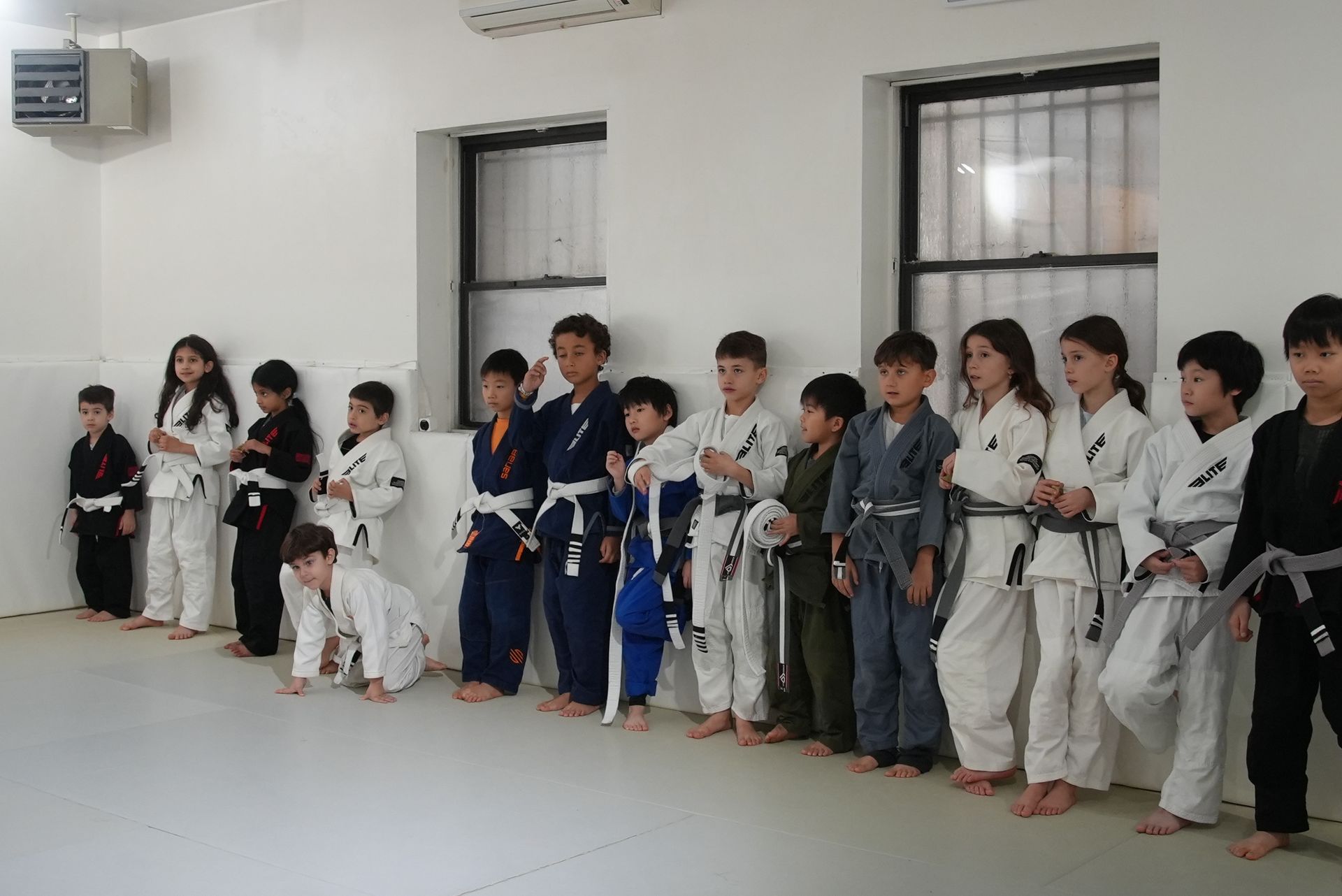
That is one reason Youth Brazilian Jiu-Jitsu can be such a powerful environment for social growth. In our youth classes, we do not just “talk about” good behavior. We coach it: how to communicate with a partner, how to handle frustration, how to take turns, how to reset after a mistake, and how to be part of a team even in an individual sport.
We also want to be clear and responsible about the claims we make. Research support is strongest for youth martial arts overall, not specifically for kids in Brazilian Jiu-Jitsu. We see BJJ as a promising tool for social skill-building when it is coached well, taught safely, and practiced consistently, not as a guaranteed fix or a substitute for professional care.
Why social skills feel harder for NYC kids (and why structure helps)
NYC kids navigate a lot: packed school days, quick transitions, and social groups that can change week to week. Many children also have less unstructured play time than past generations, which matters because “free play” is where kids historically learned negotiation, compromise, and conflict repair.
A structured program can fill part of that gap. When a class has predictable routines, consistent expectations, and adult coaching, children get more chances to rehearse social behavior in the moment. The important part is repetition. Social skills are not a lecture, they are a habit.
This is where Youth Brazilian Jiu-Jitsu in New York fits naturally into after-school life. Our classes give kids a reliable weekly space to practice being a good partner and classmate in a way that feels active and engaging, not like another sit-still activity.
What the research says (and what it does not)
When parents ask whether martial arts help with behavior and social skills, we appreciate the question because it keeps expectations realistic.
A 2025 systematic review of 16 randomized controlled trials found that children’s martial arts participation significantly increased prosocial behavior and reduced aggressive behavior. The strongest prosocial effects showed up in programs lasting around 12 to 16 weeks, with weekly sessions of about 46 to 59 minutes. That matters because it suggests consistency beats intensity.
A 2025 review in Current Sports Medicine Reports also highlighted benefits youth martial arts can support, including mindfulness, stress reduction, self-control, emotional resilience, and lower bullying-related behaviors, while emphasizing supervision, safety, and injury prevention.
Another 2025 systematic review focused on Olympic combat sports programs and reported improvements in communication, social-emotional functioning, executive function, and emotional regulation for children and adolescents with disabilities. That is encouraging, especially for families looking for activities that support inclusion.
At the same time, direct youth BJJ research is still limited. One 2024 qualitative study on Brazilian Jiu-Jitsu linked BJJ participation to meaningful goals, mental toughness, healthy habits, and positive social relationships, but it included only eight adults. Useful insight, but not something we can pretend proves outcomes for NYC kids.
So our stance is simple: Youth Brazilian Jiu-Jitsu is a strong candidate for social skill development because of how it is practiced, but results depend on coaching, culture, and fit for your child.
How Youth Brazilian Jiu-Jitsu builds social skills, one class at a time
BJJ is hands-on and partner-based. Kids cannot “hide” socially the way some can in larger team sports or loud group activities. At the same time, the structure makes social interaction feel safer because everyone follows the same rules.
Partner communication that is real, not theoretical
Kids learn quickly that successful drilling depends on simple communication: listening to instructions, asking questions, and responding to a partner’s cues. We coach kids to speak up in a clear, respectful way, especially about boundaries and comfort.
You will hear phrases like:
- Can we go lighter
- Can you show me that part again
- Are you okay
- Thank you
That might sound small, but those are practical social skills. It is hard to overstate how valuable it is for a child to practice respectful communication in real time, not just in a classroom discussion.
Cooperation, because progress requires partners
BJJ is sometimes misunderstood as purely competitive. In youth training, we treat it as cooperative learning first. A child cannot improve alone. Kids learn to help each other, take turns, and adjust intensity so both partners learn. That is social awareness in action.
We also rotate partners on purpose. Partner rotation exposes kids to different sizes, personalities, and learning styles. That builds flexibility and reduces cliques, which matters in a city where children meet peers from many backgrounds.
Respect, consent, and the tap
One of the most distinctive social lessons in BJJ is consent. We teach kids to tap when something is uncomfortable and, just as importantly, we teach kids to stop immediately when a partner taps. No debate. No “one more second.” That habit reinforces boundaries in a physical, memorable way.
Those are skills kids can carry into everyday life:
- Recognizing when someone is uncomfortable
- Responding immediately and respectfully
- Understanding that safety is shared responsibility
Emotional regulation under pressure
Social struggles are often emotional struggles underneath. When a child gets frustrated, embarrassed, or overwhelmed, social behavior can fall apart fast.
BJJ gives kids safe, age-appropriate pressure. In a controlled environment, a child gets stuck in a position, tries again, and learns to breathe and problem-solve. Over time, many kids become more patient, less reactive, and more willing to try again after a setback.
We do not promise that BJJ “treats” anxiety, ADHD, aggression, or trauma. But we do see how repeated practice with calm coaching can support healthier responses to stress.
Perspective-taking and problem-solving
Because kids work with different partners, we coach them to consider what the other person needs. A newer student may need slower reps. A smaller student may need a different starting position. A shy student may need a quick introduction before drilling.
In other words, kids practice perspective-taking without calling it that. It is built into the room.
What a socially supportive youth class actually looks like
Social skill development does not happen by accident. It comes from how the room is run: the tone, the rules, and the micro-coaching that happens between reps.
Here are a few things we build into our Youth Brazilian Jiu-Jitsu classes to keep social practice consistent:
• Predictable routines that help kids know what comes next, including warm-ups, skill time, partner drilling, and supervised games
• Clear partner rules like asking before increasing intensity, tapping early, and releasing immediately
• Coach-guided partner matching so kids are not left to negotiate size and experience differences alone
• Frequent positive reinforcement for respectful behavior, not just for “winning” exchanges
• Short, specific feedback that kids can actually apply on the next repetition
• A culture where humility matters, so skill does not turn into dominance
This structure is also why families often tell us our youth program feels like a steady anchor in a busy NYC week.
A simple social-skills framework you can watch for at home
Parents often ask what progress should look like beyond techniques and stripes. We like observable behaviors because they are practical and honest.
Over a few months of consistent training, you may notice your child starting to:
1. Greet partners without prompting and make brief eye contact
2. Take turns more smoothly, even when excited or frustrated
3. Use clear words for boundaries, like “lighter please” or “I need a break”
4. Recover faster after losing a position, instead of quitting or melting down
5. Adjust force automatically when working with smaller or newer partners
6. Ask for help appropriately rather than shutting down
7. Congratulate partners and show sportsmanship without being coached every time
Those are real social skills. And they matter in classrooms, sibling dynamics, and friendships.
Common NYC parent questions we hear, answered directly
Is Brazilian Jiu-Jitsu safe for kids
It can be safe when it is taught progressively, supervised closely, and centered on tap-and-release rules. We also take hygiene and mat cleanliness seriously, and we keep intensity age-appropriate. If you are evaluating any youth activity, ask about injury protocols, how mismatches are handled, and how coaches manage rough behavior early before it escalates.
Will BJJ make my child more aggressive
Well-structured youth martial arts programs generally show the opposite pattern in research, with increased prosocial behavior and reduced aggression in controlled studies. Culture matters, though. In our room, we coach control, cooperation, and respect. We do not reward intimidation. We reward good partnering.
What age should my child start
Readiness matters more than a specific age. Younger kids often benefit from simple movement games, listening practice, and basic positions. Older kids may be ready for more technical sequences and controlled sparring. If you are unsure, a trial class is usually the easiest way to see fit.
Does my child need to be athletic
No. Youth Brazilian Jiu-Jitsu is skill-based and scalable. Kids who do not enjoy traditional team sports often like BJJ because it feels like solving a puzzle with a partner. We meet beginners where they are and build from there.
Can this help a shy kid make friends
It can help because partner work creates repeated, low-pressure interactions. We also guide partner rotation so kids get plenty of chances to work with different classmates. That said, we never frame BJJ as an instant cure for social anxiety. We frame it as consistent practice in a supportive setting.
What if my child has ADHD, autism, anxiety, or sensory sensitivities
We encourage you to talk with us about your child’s needs. Clear routines, visual demonstrations, predictable transitions, and flexible participation can make a big difference. Research on combat sports programs suggests possible gains for some children with disabilities in communication and social-emotional functioning, but it is always individual. We also never position training as a replacement for medical or mental health support.
How often should kids train to see social benefits
Consistency matters more than cramming. The 2025 randomized-trial review found meaningful prosocial effects in programs around 12 to 16 weeks with weekly sessions near an hour. For many families, one or two well-coached classes per week is a realistic start, especially with NYC schedules.
Take the Next Step
If you want an activity that builds more than fitness, Youth Brazilian Jiu-Jitsu can give your child repeated, coached practice in communication, cooperation, boundaries, and calm problem-solving. When the environment is structured and supportive, those lessons tend to show up outside the academy, too, in small moments that add up.
We designed our youth program at Range Brazilian Jiu-Jitsu NYC to be consistent, safety-first, and genuinely welcoming for New York families, with clear expectations on the mat and a community feel that makes it easier for kids to connect.
Ready to put your skills into practice? Start training at Range Brazilian Jiu-Jitsu NYC.