Resilience is not a personality trait your child either has or does not have, it is a skill we can train on the mats.
Parents in New York ask us a version of the same question all the time: how do we help kids handle pressure without breaking down, shutting down, or acting out? Between school demands, packed schedules, social stress, and the general intensity of city life, kids need more than motivation. They need practice staying calm when something feels hard.
Youth Brazilian Jiu-Jitsu works so well for this because it turns challenge into something concrete and repeatable. In class, your child faces small problems, solves them with technique, and learns that discomfort is temporary and manageable. We do it in a structured, age-appropriate way, and we keep the environment safe and respectful so kids can take healthy risks without fear of getting embarrassed or hurt.
In this article, we will break down exactly how youth Brazilian Jiu-Jitsu in New York builds resilience, what a typical class looks like, what progress tends to look like over time, and how competition opportunities in New York can support (not replace) personal growth.
What resilience looks like for NYC kids (and why it is learnable)
Resilience gets described in big, fuzzy words, but in real life it is pretty specific. It is the ability to recover after losing, getting corrected, feeling tired, or being surprised. For kids, resilience often shows up as simple behaviors: staying engaged instead of quitting, trying again after making a mistake, and regulating emotions when something does not go their way.
In Brazilian Jiu-Jitsu in New York, we train those behaviors directly. Not through lectures, but through experience. Your child gets immediate feedback from the situation: a grip breaks, a balance shifts, a position gets lost. The lesson becomes, OK, reset, breathe, try the next step. Over time, that reset mindset becomes normal.
City kids also deal with sensory overload more than most people realize. Loud streets, crowded subways, fast transitions, constant stimulation. A good youth class becomes a kind of “focused room” where attention is trained like a muscle. That focus helps resilience because many meltdowns are not about weakness, but about overload.
Why Youth Brazilian Jiu-Jitsu builds resilience better than “just getting tougher”
We never try to “toughen kids up” by pushing them past their limits for no reason. That approach usually backfires. Instead, our goal is to help kids build confidence through competence, and competence comes from doing the right things consistently.
Youth Brazilian Jiu-Jitsu is unique because it is a problem-solving sport under pressure. Kids learn to:
• Stay calm when someone is on top of them in a controlled way
• Use leverage and angles instead of panicking or muscling everything
• Accept corrections as normal, not as a personal criticism
• Keep working even when a technique does not land the first time
When your child experiences challenge every week and learns that the solution is “keep thinking and keep moving,” resilience becomes practical. It is not motivational. It is trained.
Inside a typical youth class: structure that supports confidence
A lot of parents want to know what actually happens during a youth session, because “martial arts class” can mean many different things. Our youth Brazilian Jiu-Jitsu classes typically run in a focused, kid-friendly format that fits attention spans and keeps kids moving. Many programs in New York use 45-minute sessions for youth, and that structure works well because it gives enough time for skill development without dragging.
What your child practices each week
We keep class predictable enough to feel safe, but varied enough to stay interesting. A typical class includes:
• Technique instruction with a clear theme, like escapes, control, or takedown basics
• Partner drilling where kids repeat the movement until it feels natural
• Controlled live training (often called rolling) scaled to age and experience
• Strength and conditioning that supports movement quality, not just fatigue
• Flexibility and body-awareness work to improve coordination and reduce injury risk
The resilience piece is baked into all of it. Drilling teaches patience. Rolling teaches composure. Conditioning teaches “I can do hard things,” but in a measured dose.
Rolling and “safe struggle”: where resilience really gets trained
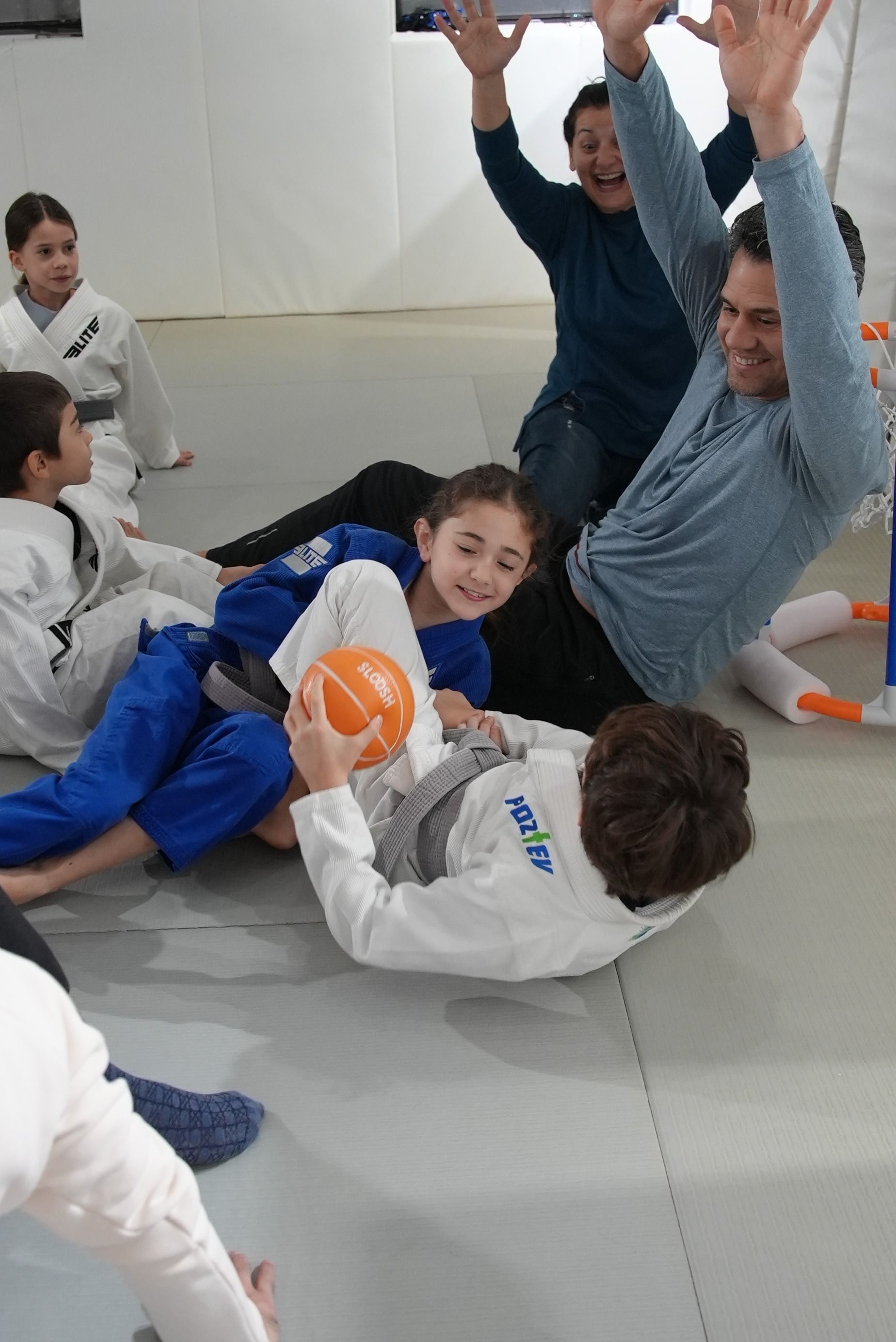
Live training is where many of the mental benefits come alive. Rolling is not a brawl. It is a supervised, rules-based practice where kids learn timing, distance, and decision-making with a partner who is also learning.
In those moments, kids face a kind of safe struggle. They experience being stuck and discover that stuck is not the same as hopeless. We coach them to create tiny wins: frame, hip escape, recover guard, stand up, reset. Each tiny win is a resilience rep.
This matters in school and social life, too. When kids learn, “I can breathe and problem-solve under pressure,” that skill travels. You may notice your child taking feedback better, recovering faster from disappointment, or speaking up with more confidence. Not every week is dramatic, but the trend is real when training is consistent.
Discipline without harshness: how we teach kids to stay accountable
Resilience is not only about enduring hard moments. It is also about showing up when you would rather not. That is discipline, and we teach it in a way that feels fair to kids.
We use clear expectations: listening during instruction, treating partners with respect, using controlled movement, and staying engaged even when a drill feels repetitive. If a child gets distracted (it happens), we redirect and bring them back into the room. Over time, that becomes a habit: attention, then action.
We also emphasize sportsmanship. Youth Brazilian Jiu-Jitsu gives kids a structured way to compete without disrespect. Win or lose, we expect composure, a handshake, and a learning mindset. That kind of emotional control is a major part of resilience.
Progress in Youth Brazilian Jiu-Jitsu: what parents can realistically expect
Parents love timelines, and we get it. New York families plan everything. While every child progresses differently, youth belt systems are designed to reward consistency, technical growth, and maturity. National surveys often place the average time to blue belt around 2.3 years for youth starters (depending on age and promotion policies), which is a helpful reference point for the idea that progress is steady, not instant.
What we like parents to watch for is less “belt chasing” and more capability:
• Your child remembers steps without being prompted
• Your child can stay calm when a position goes wrong
• Your child starts helping newer students during drills
• Your child can roll safely with different partners and sizes
Those signs are resilience in action. Belts are meaningful, but the deeper win is the child who knows how to keep going.
Resilience for different ages: kids and teens need different coaching
Youth Brazilian Jiu-Jitsu is not one-size-fits-all. A younger child may need more games-based movement, more repetition, and shorter instruction blocks. A teen might want more technical depth, a little more intensity, and clearer performance goals.
We adapt the coaching style so resilience develops at the right pace. For younger kids, resilience often means staying on task, handling frustration, and learning to share space with partners. For teens, resilience often includes managing ego, dealing with fatigue, and learning to perform under pressure without spiraling.
And yes, teens sometimes arrive skeptical. We do not fight that. We channel it. Once a teen realizes the sport is technical and real, the buy-in tends to come naturally.
Safety and trust: the foundation of resilient training
Parents should ask about safety. We welcome that question. The safest youth environments are the ones with structure: clear rules, supervision, appropriate pairings, and a culture where respect is non-negotiable.
We keep training controlled, we teach kids how to move without crashing into each other, and we set boundaries around intensity. Kids learn to tap and to stop immediately. That tap culture is important beyond safety because it teaches self-advocacy. A resilient kid is not one who absorbs everything, but one who knows when and how to respond.
New York competition opportunities: how tournaments can support resilience
New York has a very active youth scene, which is one reason youth Brazilian Jiu-Jitsu in New York has grown so quickly. Events like IBJJF tournaments in the area award hundreds of medals across many divisions, which shows how many kids are participating and how structured the competitive pathway can be. There are also youth divisions in other major circuits that regularly stop in the NYC area.
Competition is not required. But for the right kid, at the right time, it can be a powerful resilience accelerator. Preparing for a tournament teaches goal-setting, patience, and how to manage nerves. Competing teaches emotional control in a very honest way. And afterward, kids learn to review what happened without shame.
We talk to parents about readiness, not just interest. If your child struggles with anxiety, competition may still be helpful, but we approach it carefully and build confidence first through consistent training and small challenges.
Practical guidance for New York parents: cost, consistency, and routines
Training in New York is an investment. Average BJJ gym dues in NYC are often around $173 per month, which reflects demand and the reality of operating in the city. The good news is that the return is not only physical fitness. You are building habits that can shape your child’s approach to school, friendships, and long-term health.
To get the most out of youth Brazilian Jiu-Jitsu, consistency matters more than intensity. Two or three classes per week, done steadily, usually beats sporadic bursts of training. We also encourage simple routines: packing the gi the night before, eating a light snack after school, arriving a little early to settle in. Those small habits reduce stress and help kids show up ready to learn.
If you are wondering whether your child is “athletic enough,” we see all types. Coordination and endurance improve quickly when kids train regularly. The sport meets your child where your child is.
Take the Next Step with Range Brazilian Jiu-Jitsu NYC
Resilience is built one rep at a time: one escape that finally works, one tough round that gets finished, one moment where your child chooses calm instead of panic. That is what we train for every week, and it is why Youth Brazilian Jiu-Jitsu can be such a strong fit for families raising kids in New York.
If you want a place where your child can work hard, feel supported, and grow into real confidence, our youth program at Range Brazilian Jiu-Jitsu NYC is designed to make that progress feel steady and achievable, not overwhelming.
Train with intention and elevate your performance by joining a Brazilian Jiu-Jitsu class at Range Brazilian Jiu-Jitsu NYC.